
Patents, geopolitics, and the battle for 6G standards.
Key Takeaways
- The window for 6G IP strategy closes before deployment, with today’s 6G patents possibly standard-essential patents by 2028.
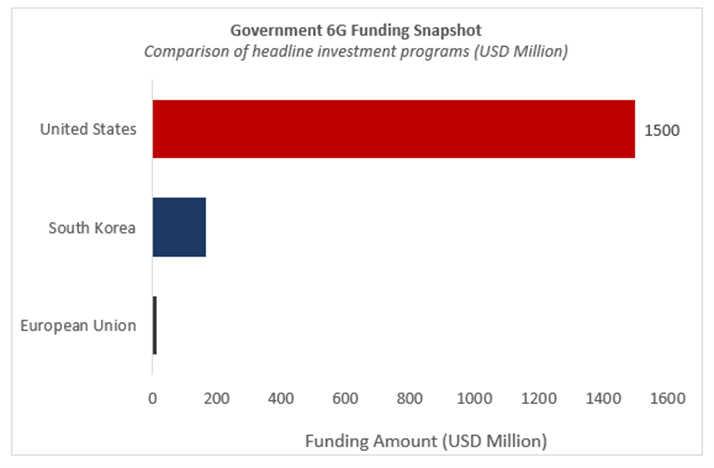
- Governments are investing billions, including U.S. $1.5B, South Korea KRW 220B, and EU €12M Hexa-X, driving 6G research investment.
- China leads the global 6G patent race with 40.3 percent of filings, the U.S. follows with 35.2 percent, and Huawei plus State Grid dominate.
- Universities drive commercialization, with Oulu’s 6G Flagship linking 73 countries and 32 partners, showing the power of university 6G research partnerships.
- 6G standardization remains contested, with 1,500 delegates debating 5G evolution versus new networks.
Introduction
The race to define sixth-generation wireless technology is already underway. Patent offices, standards bodies, and government programs across continents are moving fast to secure influence. Commercial 6G networks may be nearly a decade away, but the 6G intellectual property that will shape leadership and 6G licensing revenue is being built now.
In this article we explore the imperative of pre-standard patent strategy, the flow of geopolitical competition, the global 6G patent landscape, the role of universities in telecom standard essential patents, and the contested terrain of 3GPP 6G standards and IMT-2030 standards.
The Pre-Standard Patent Imperative
Technical work in 3GPP 6G standards begins in Q3 2025, with the first 6G technology patents expected by 2028 in Release 21. Patents filed today come years before the standard but must anticipate future mandatory implementations. The ITU will accept IMT-2030 standards submissions in early 2027, creating a narrow window to secure positions as 6G standard essential patents.
This pre-standard phase favors those who predict which approaches will survive consensus. Companies and research institutions are filing patents on terahertz communication, AI-native networks, and integrated sensing. Patents that become mandatory parts of the 6G standard turn into telecom standard essential patents, commanding FRAND licensing telecom terms across the global industry.
Geopolitical Capital Flows
Government funding is accelerating 6G research beyond market forces. The United States has committed $1.5 billion through the CHIPS Act, with $530 million already distributed to projects on open radio units and 6G physical layer technologies. A recent $117 million allocation supported nine projects, including Rampart Communications with Virginia Tech. South Korea has structured its investment with precision.
The Ministry of Science and ICT plans to allocate KRW 220 billion through 2025 across three strategic pillars. These include securing next-generation technologies, gaining dominance in international standards and patents, and building foundational research infrastructure. The plan also sets timelines for satellite deployment, with 14 low-earth orbit satellites scheduled for launch by 2031.
Europe focuses on consortium-based research. The Hexa-X project, funded with €12 million, unites 25 industry and academic partners led by Nokia to develop frameworks and core technologies. These investments show clear priorities. The United States emphasizes resilience and open architectures, South Korea targets standards and space infrastructure, and Europe builds shared technical frameworks.
The Patent Filing Landscape
The global distribution of 6G patent applications shows concentrated strategic investment. Analysis by RCR Wireless and Cyber Creative Institute finds China with 40.3 percent of filings, the United States with 35.2 percent, Japan with 9.9 percent, Europe with 8.9 percent, and South Korea with 4.2 percent. The survey of nearly 20,000 applications across nine core technologies highlights China’s focus on mobile infrastructure.
Huawei founder Ren Zhengfei explained the strategy, noting the company aims to secure 6G patent ground without waiting for viability. Huawei began investing in 2017, years before 3GPP’s official commitment. Ericsson illustrates a different approach. The company set its 6G vision in 2019 and now holds more than 60,000 granted patents. In 2024, Ericsson generated SEK 14 billion in licensing revenue, reinvesting about 19 percent of annual global revenue into research.
The University Nexus
Academic institutions are central to 6G intellectual property strategy. The University of Oulu’s 6G Flagship links 73 countries and 32 industry partners, offering commercialization pathways and IP management. The University of Texas launched a 6G research center backed by Samsung, Qualcomm, AT&T, and Nvidia, while South Korea’s KAIST partners with LG. These university 6G research partnerships serve multiple roles.
Corporations gain access to 6G technology patents, universities convert research into assets, and nations influence 6G standards and patents through technical input and voting power. Global engagement was clear at the 3GPP Bengaluru meetings in August 2025. More than 1,500 delegates from over 50 countries attended, which the Indian government described as the highest participation ever in a 3GPP working group meeting.
Standardization as Strategic Terrain
Standardization has become strategic terrain. The 3GPP commitment to develop 6G specifications, announced in December 2023, turned research into a coordinated global effort. Beneath this consensus remain deep technical disagreements. Reports from EE Times note that many in China’s telecom ecosystem push for a new 6G core network, while others prefer evolving the 5G core. These debates decide which patent portfolios keep value, which infrastructure can be reused, and which companies face transition costs.
The Joint Statement Endorsing Principles for 6G, signed by ten nations including the United States, key EU members, Japan, and South Korea, reflects an effort to align like-minded nations against divergent visions.
Final Strategic Takeaways
The foundation of 6G intellectual property is being set during a brief window that opened in 2017 and will close with Release 21 in 2028. The 6G patents filed, the standards positions taken, and the partnerships formed will determine who owns 6G standard essential patents and who earns 6G licensing revenue from every device. With China and the U.S. accounting for over 75 percent of filings, the global 6G patent race is more concentrated than 5G, creating both opportunities and dependencies that will shape the future telecom patent landscape through the 2030s.
Recommendations for Stakeholders
- Telecommunications Equipment Manufacturers
- File 6G technology patents early to secure priority.
- Form partnerships with universities before 3GPP mobilizes in Q3 2025.
- Government Policymakers
- Ensure domestic entities contribute with voting power in 3GPP 6G standards and IMT-2030 standards.
- Design funding programs that reward 6G standardization and patent generation.
- University Technology Transfer Offices
- Build expertise in telecom standard essential patents and FRAND licensing telecom.
- Strengthen ties with corporate partners for standards participation.
- Emerging Market Operators
- Engage in regional bodies linked to ITU to shape infrastructure investments.
- Follow 6G patent filing trends and debates on core network evolution.
- Industry Stakeholders
- Recognize that the pre-standard phase defines 6G licensing revenue and global influence in the 6G patent landscape.
- Align 6G IP strategy early to secure leadership.