
Unpacking the legal, economic, and strategic realities of “royalty-free” standards.
Key Takeaways
- Royalty‑free vs FRAND licensing and standard essential patents (SEP) licensing drive open standards patent risks, codec intellectual property disputes, and broader technology innovation incentives in the video codec patent ecosystem.
- Royalty‑free technology standards hide the hidden costs of royalty‑free standards, with cross‑licensing reducing returns and shaping video codec royalty economics.
- AV1 codec licensing risks show the Alliance for Open Media licensing model cannot prevent AV1 patent litigation risk.
- Submarine patents in technology standards and patent ambush in technology standards create infringement threats.
- Open standards compliance costs highlight open source compliance risk.
Introduction
The launch of the AV1 video codec by the Alliance for Open Media licensing model was hailed as a breakthrough in royalty‑free technology standards, promising to reshape the video codec patent ecosystem. Yet beneath these claims lies a reality of hidden costs of royalty‑free standards, AV1 codec licensing risks, and exposure to open standards patent risks that organizations must carefully evaluate. The question is no longer whether royalty‑free standards are truly free, but what price companies pay when adopting them.
In this study we explore the economics of “free” licensing and video codec royalty economics, the specter of submarine patents in technology standards, the risks of late assertions and patent ambush, and the compliance costs for open source standards that shape long‑term outcomes in the FRAND vs royalty‑free licensing explained debate.
The Economics of Royalty-Free Licensing
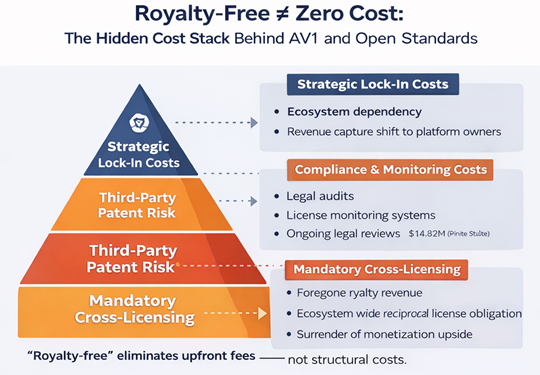
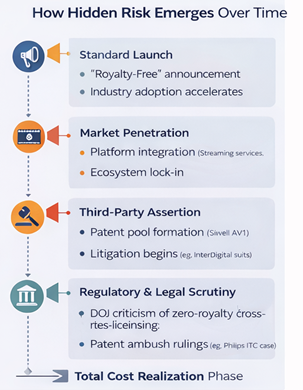
The debate over royalty‑free technology standards highlights the hidden costs of royalty‑free standards. The U.S. Department of Justice has criticized these models, noting that mandatory cross‑licensing among dominant implementers can act as a collusive scheme fixing royalties at zero. This paradox underscores AV1 codec licensing risks and broader video codec royalty economics.
The Alliance for Open Media licensing model requires reciprocal, royalty‑free licenses for patents essential to AV1. In practice, patent‑rich companies surrender significant revenue across the entire video codec patent ecosystem. As IP Europe explains, the “price” is the total value of foregone royalties, often reaching millions.
Hidden economics also emerge in practice. Sisvel notes that Google and AOMedia members monetize indirectly. For example, Google’s Android, marketed as “free,” generated $24.8 billion in 2018 via ads and app sales. Similarly, AV1 adoption avoids direct royalties but funnels value into consortium revenue streams, ultimately passing costs to consumers.
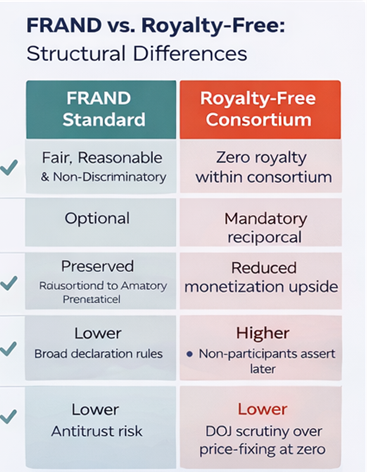
This shows how royalty‑free vs FRAND licensing differs: FRAND frameworks balance open standards patent risks with intellectual property licensing incentives, while “free” models redistribute costs in ways that can weaken technology innovation incentives.
The Specter of Submarine Patents
The threat of submarine patents in technology standards shadows royalty‑free technology standards. These delayed applications let industries adopt technologies before patents emerge, creating open standards patent risks and unexpected AV1 patent litigation risk.
George Selden delayed his automobile patent until the industry was committed. Jerome Lemelson held back filings on bar code readers and ATMs. These cases show the hidden costs of royalty‑free standards and risks across the technology standards ecosystem.
Legal reforms reduced classic submarine patents but risks remain. Long prosecution periods allow claims to be modified to match industry norms. For companies using the AV1 codec licensing model, undisclosed patents may surface later, leading to codec intellectual property disputes and costly litigation.
These risks highlight why FRAND vs royalty‑free licensing explained is critical for balancing patent licensing frameworks, technology innovation incentives, and the health of the video codec patent ecosystem.
Late Assertions and Patent Ambush in Open Standards
Late assertions create serious open standards patent risks even without deliberate submarine patents in technology standards. In ITC case 337‑TA‑1240, four Philips patents were ruled unenforceable after a six‑year delay in declaring them standard essential patents (SEP) licensing. The judge called this patent ambush in technology standards, where patentees hold up industry after adoption.
Cases like Hynix v. Rambus and Qualcomm v. Broadcom show that breaching disclosure duties can lead to unenforceability under implied waiver. Yet many patent holders avoid standards development organizations, leaving implementers exposed.
The AV1 ecosystem shows the risk clearly. Research found seven U.S. district court cases tied to AV1 and 56 linked to VP9, exposing gaps in the AV1 codec licensing model and its “royalty‑free” claims. In 2025, InterDigital sued Amazon over video compression and HDR patents, targeting Prime Video and Fire TV, both relying on AV1. These disputes highlight AV1 codec licensing risks, AV1 patent litigation risk, and the hidden costs of royalty‑free standards in the video codec patent ecosystem.
The Compliance Cost Burden
Beyond AV1 patent litigation risk, organizations face heavy open standards compliance costs when adopting royalty‑free technology standards. Research from Finite State shows the average cost of non‑compliance with open source licenses is $14.82 million. This includes legal penalties, resources to fix gaps, and product recalls. These figures reveal the hidden costs of royalty‑free standards and broader open source compliance risk.
Compliance obligations span audits, monitoring systems, and legal reviews. Companies must track dependencies, ensure modifications do not create new issues, and hire specialized counsel at premium rates. For firms using the AV1 codec licensing model, these costs accumulate even without direct royalties, shaping video codec royalty economics.
The Sisvel AV1 codec patent pools, covering about half the AV1 market, show that many implementers still pay fees. Patent holders outside the Alliance for Open Media licensing model did not commit to royalty‑free terms. They retain rights to charge, set conditions, or seek injunctions. This creates codec intellectual property disputes and reinforces open standards patent risks in the video codec patent ecosystem.
Final Strategic Takeaways
The debate over royalty‑free vs FRAND licensing highlights tensions in the technology standards ecosystem. Zero‑cost licensing looks appealing, but costs are redistributed, not removed. Adopters of royalty‑free technology standards face mandatory cross‑licensing, loss of IP rights, exposure to third‑party assertions, open standards compliance costs, and AV1 patent litigation risk. The DOJ warns that mandatory royalty‑free models among dominant implementers can act as collusive schemes fixing royalties at zero. This weakens technology innovation incentives and distorts video codec royalty economics.
Wrapping Up
Companies must assess total cost of ownership, including hidden costs of royalty‑free standards, compliance monitoring, litigation reserves, and strategic impacts. The choice between the AV1 codec licensing model and FRAND frameworks will shape long‑term outcomes in the video codec patent ecosystem. Transparent FRAND vs royalty‑free licensing explained offers a path to balance openness with sustainable innovation.
Recommendations for Stakeholders
- Technology Implementers
-
- Account for compliance monitoring, legal reviews, and litigation reserves to capture the hidden costs of AV1 codec adoption.
- Map patents under consortium commitments and identify third‑party rights holders outside the Alliance for Open Media licensing model.
- Perform IP due diligence before adopting royalty‑free technology standards.
- Standards Development Organizations
-
- Mandate early patent declarations with enforcement mechanisms such as implied waiver.
- Consider hybrid models that balance patent licensing frameworks and technology innovation incentives.
- Avoid positioning zero‑royalty terms as the only path to openness.
- Patent Holders and Innovators
-
- Evaluate trade‑offs between proprietary “royalty‑free” consortiums and FRAND‑committed bodies.
- Maintain clear records of standard essential patents (SEP) licensing and disclosure timelines.
- Prevent risks of patent ambush in technology standards.
- Policymakers and Regulators
-
- Ensure antitrust oversight of mandatory cross‑licensing among market leaders.
- Distinguish transparent FRAND processes from proprietary “royalty‑free” schemes.
- Safeguard competition and technology innovation incentives.
- Investors and Industry Analysts
-
- Scrutinize AV1 codec licensing risks and the video codec patent ecosystem when evaluating portfolios.
- Consider open source compliance risk, litigation exposure, and sustainability of “free” models.
- Assess whether technology patent pools and consortium strategies align with long‑term growth.