

How Bluetooth LE Audio, Spatial Sound, and Immersive Media are Creating New IP Choke Points
Key Takeaways
- Audio codecs are now a SEP battlefield, shaping wireless audio codec licensing and immersive sound.
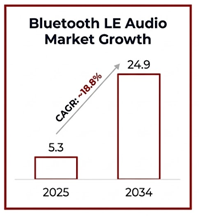
- Bluetooth LE Audio with LC3 codec drives a $24.9B market shift by 2034.
- Dolby’s spatial audio patents force costly licensing or alternatives.
- Wearables intensify codec wars, with efficiency and multi‑stream as key differentiators.
- Hidden SEPs expose companies to surprise licensing and litigation risks.
Introduction
Audio codecs are the hidden tools behind wireless audio technology. They compress audio so it can travel over Bluetooth audio codecs and other systems, powering everything from music streaming to voice calls. Without them, modern wireless audio would not exist. These codecs are not just technical features; they represent years of innovation protected by audio codec patents and have become a major source of patent battles. Companies compete fiercely for control of audio codec licensing revenues, knowing that codec ownership defines the future of wireless experiences. The Bluetooth LE Audio market is growing fast. It is expected to rise from $5.3 billion in 2025 to $24.9 billion in 2034. The invisible infrastructure behind every wireless experience is built on codec patent portfolios, and whoever controls them controls big revenue. Fraunhofer earned more than one billion euros from MP3 and AAC licensing, showing how powerful codec portfolios can be. In this article, we explore codec patent concentration, the rise of LC3 in the Bluetooth audio revolution, the fortress of spatial audio patents, the growing royalty stack in wearables, the hidden risks of patent pools, and the role of litigation in enforcement.
The Patent Concentration Problem
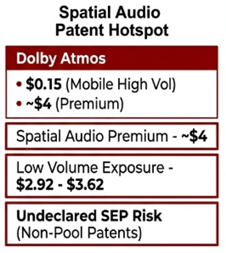
According to a comprehensive patent landscape analysis by LexisNexis IPlytics, Fraunhofer and Dolby dominate the audio codec patent landscape across AAC, Opus, MPEG-H, and EVS codecs, maintaining the largest and highest quality patent portfolios. A single codec implementation may require codec licenses costs from dozens of patent holders. Black Stone IP’s analysis revealed that implementing MPEG-H 3D Audio licensing requires incorporating six underlying standards, spanning over 2,000 individual patents from dozens of companies. The financial implications are substantial. For low-volume products shipping 500,000 units, estimated MPEG-H 3D Audio licensing costs range from 2.92 to 3.62 dollars per unit. Even at 75 million units, manufacturers face 0.44 to 0.80 dollars per device in codec licensing alone.
LC3 and the Bluetooth Revolution
LC3 codec, the Low Complexity Communication Codec, is the foundation of Bluetooth LE Audio. It marks a major upgrade in Bluetooth audio codec technology. According to Bluetooth SIG testing, LC3 delivers quality scores of about 4.5 at 160 kbps on a five‑point scale. In comparison, SBC needs 345 kbps to barely exceed a score of 4.0. This efficiency improves wearable audio technology performance. LC3 also enables new features that older standards could not support. True wireless stereo becomes native, and multi‑stream audio introduces fresh use cases through Auracast broadcast audio. Manufacturing data shows strong adoption. By 2024, about 60% of audio models included LE Audio, and by 2025, Bluetooth Classic‑only hardware is expected to be fully phased out.
Spatial Audio’s Patent Fortress
Dolby holds a strong position in spatial audio patents. Patent experts describe Dolby Atmos patents as “hard to bypass,” showing rare protection in complex technology. Spatial audio licensing rates reflect this strength: mobile devices at high volume cost about 0.15 dollars per unit, while premium implementations reach around 4 dollars per device. By contrast, MPEG-H 3D Audio licensing ranges from 0.44 to 0.80 dollars per unit at high volumes. This highlights Dolby’s ability to charge premium dollars and maintain a clear edge in the spatial audio market.
Wearables and the Royalty Stack
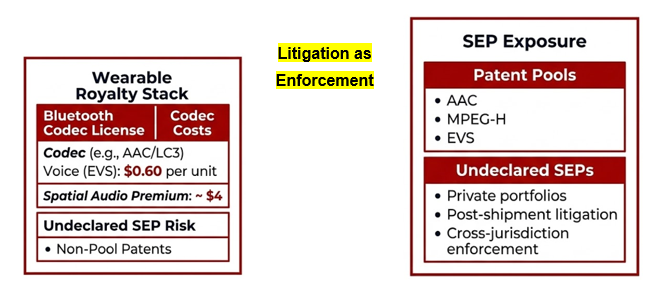
Modern premium true wireless earbuds require multiple codec licenses. Beyond Bluetooth audio codecs, spatial audio features demand 3D audio processing licenses. Voice assistant integration requires EVS codec licensing, which Via Licensing licenses at 0.60 dollars per unit. The cumulative royalty burden can exceed ten dollars per device before accounting for non-codec patents. AR and VR headsets face even greater complexity. Meta’s Quest 3 implements eight-channel spatial audio processing requiring multiple patent licenses. Apple’s alternative strategy involves developing proprietary spatial audio technology, avoiding per-device licensing costs through substantial research investment.
Patent Pools and Hidden Risks
Via Licensing Alliance manages major audio codec patent pools, offering one stop codec patent pool licensing for AAC, MPEG-H, and EVS. The AAC pool includes over 900 licensees with royalty rates from 0.10 to 0.98 dollars per unit. However, LexisNexis IPlytics analysis emphasizes that hidden SEPs in audio codec standards remain outside formal declarations and patent pools. These undeclared patents create hidden risks for unexpected licensing demands or litigation after products ship.
Litigation as Enforcement
Philips and Transsion engaged in audio codec litigation over AAC and USAC codecs before settling. Fraunhofer has pursued litigation over EVS patent enforcements, expanding from the Unified Patent Court to U.S. courts. Dolby’s global codec patent enforcement actions span multiple jurisdictions, even asserting patents against manufacturers who believed Opus represented an open alternative.
Wrapping Up
Fraunhofer and Dolby’s dominance results from decades of sustained research investment, creating patent portfolios that generate substantial audio codec licensing revenues while constraining competitors’ strategic options. For manufacturers, understanding the full scope of patent exposure, including undeclared SEPs, enables accurate cost modeling and risk assessment. The evidence establishes that audio codecs have emerged as critical competitive battlegrounds for wireless audio patents where intellectual property strategy drives market outcomes as much as engineering excellence or consumer preference.
Recommendations for Stakeholders
- Device Makers: Check the full patent landscape before building products. Hidden SEPs can add surprise costs or lawsuits later.
- Patent Owners: Enforce rights fairly. If licensing fees are too high, companies may switch to alternative codecs.
- Standards Bodies: Improve transparency. Require stronger SEP declarations so implementers know the real risks.
- Legal Teams: Build technical knowledge of codecs. Stay updated on FRAND rulings and litigation trends to guide strategy.
- Industry Stakeholders: Plan for royalty stacking in wearables and immersive devices. Factor codec costs into product pricing early.