

Who Really Wins Video Codec Wars: AV1 vs HEVC vs VVC
Compression performance meets patent pools in the next codec battle
Key Takeaways
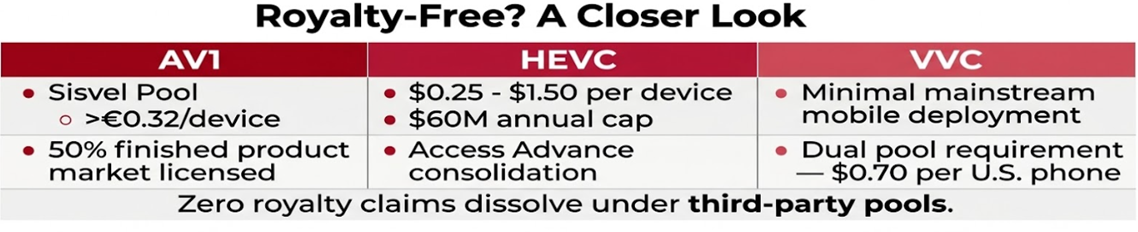
- AV1’s “royalty‑free” claim is misleading, with Sisvel charging up to €0.32 per device.
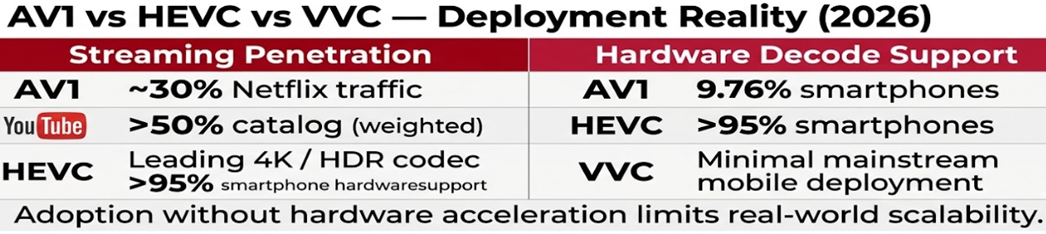
- By late 2025, AV1 carried 30% of Netflix traffic, but only 9.76% of smartphones supported hardware decode.
- HEVC dominates with 95% smartphone penetration and leads in 4K HDR streaming.
- VVC rollout is slow, with royalties between $0.45 and $1.70 per device and minimal mobile support.
- Access Advance added a new royalty layer in Jan 2025, costing streaming platforms up to $63M annually.
Introduction
The codec wars are no longer just about sharper video or smaller files. They are about AV1 vs HEVC vs VVC, where technical gains collide with video codec patent licensing, fragmented video codec patent pools, and the economics of streaming. What looks like a simple video codec comparison hides deeper conflicts: uneven hardware video decoding support, rising codec royalty fees, and the challenge of aligning video compression technology with commercial realities. The video codec war between AV1, HEVC, and VVC reflects a broader shift in video compression standards and the evolution of next generation video codecs. Streaming platforms must balance video codec licensing costs, ensure hardware video decoding availability, and manage the economics of streaming platform codecs while navigating fragmented patent pool licensing models. In this article, we explore how the promise of royalty‑free licensing has unraveled, why hardware adoption lags, how the HEVC video codec maintains dominance, why the VVC codec struggles to gain traction, and how new video codec patent pools are reshaping streaming economics.
The Royalty Free Myth Unravels
AV1 was launched in 2018 by the Alliance for Open Media with support from Amazon, Google, Netflix, and others. It was promoted as a royalty free alternative to HEVC’s complex licensing system. The technical gains were real. Netflix reports AV1 now powers 30 percent of viewing on its platform. It delivers VMAF scores 4.3 points higher than AVC and 0.9 points higher than HEVC while using one third less bandwidth. YouTube has made more than half of its catalog available in AV1 when measured by watch time. The royalty free claim has not held up. Sisvel International created an AV1 patent pool outside AOMedia’s policy. Sisvel charges 0.32 euro per consumer display device, including smartphones and televisions. Compliant licensees pay 0.24 euro. The pool covers about half of the AV1 finished product market, removing the zero cost promise for many implementers. The U.S. Department of Justice has raised antitrust concerns. DOJ official Dina Kallay noted that royalty free cross licensing among dominant consortia can be harmful. Critics argue AOMedia’s Patent License forces reciprocity. Implementers must make their own standard essential patents available under the same terms. This viral obligation may discourage participation by companies with large patent portfolios.
The Hardware Adoption Bottleneck
AV1 shows strong software support across browsers. Hardware acceleration, however, remains limited. ScientiaMobile data reveals that only 9.76% of smartphones had hardware-supported AV1 decode in Q2 2024, driven mainly by Apple’s iPhone 15 Pro models. In comparison, HEVC hardware decode exceeds 95%, giving the older codec a clear advantage in mobile deployment. This gap matters. Software-only decode creates heavy computational costs. CPU-based AV1 decoding drains batteries, generates heat, and struggles to deliver smooth playback across devices. The 8th Annual Bitmovin Video Developer Report shows AV1 utilization at just 13% in 2024–2025, well below projections. The report links this shortfall to the lack of a compelling use case. HEVC succeeded by enabling 4K and HDR delivery. AV1 offers bandwidth efficiency, but with CDN bandwidth optimization costs now at $0.005 per GB, financial motivation for new codec adoption has weakened.
HEVC’s Persistent Dominance
HEVC continues as the de facto standard for premium video delivery. It leads HEVC 4K HDR streaming in 2024, with industry surveys showing confidence in further growth. The codec benefits from a mature hardware ecosystem, established workflows, and near-universal device support built since its 2013 release. Licensing remains costly. Access Advance manages the HEVC Advance Patent Pool, with rates from $0.25 to $1.50 per device, capped at $60 million annually. In December 2025, Access Advance acquired Via Licensing Alliance’s HEVC and VVC programs, consolidating patent pools. Companies that secure licenses before June 30, 2026 can lock in current rates before scheduled increases.
VVC’s Stalled Momentum
Versatile Video Coding (VVC) was finalized in July 2020 as the successor to HEVC. It promised about 50% better VVC compression efficiency. Despite this advantage, adoption remains minimal four years later. Major streaming platforms have not deployed VVC for consumer delivery. Hardware support is limited to niche segments. MediaTek announced VVC decoding for televisions, and Intel’s Lunar Lake processors include support. Mainstream mobile chipsets still lack VVC hardware capability. Licensing adds further challenges. MPEG LA charges $0.20 per unit for hardware and paid software, with a $30 million annual cap. Access Advance operates the VVC Advance Patent Pool with rates from $0.25 to $1.50 per device and a $60 million cap. The two pools represent different patent holders, so implementers usually need both licenses. For most licensees, the combined cost for HEVC and VVC on a phone sold in the United States is $0.70. This creates economic friction that requires either regulatory pressure or strong technical necessity to justify.
The Video Distribution Patent Pool Wildcard
In January 2025, Access Advance introduced a new licensing model. The Video Distribution Patent Pool (VDP Pool) targets streaming services directly. It covers HEVC, VP9, AV1, and VVC under one structure. Top-tier services face charges of $5.25 million per month or $63 million annually. Early licensees signing before June 30, 2026 receive a 12.5% discount valid through 2035. The impact goes beyond revenue. The VDP Pool removes codec choice arbitrage. Streaming platforms cannot avoid HEVC royalties by shifting to AV1, or bypass VVC obligations by staying on older formats. All major streaming video codecs fall under the same pool. This changes the strategic equation for platforms. Bandwidth savings from newer codecs no longer reduce intellectual property costs. A key financial incentive for adopting AV1 or VVC is effectively removed.
Final Strategic Takeaways
The codec market in 2026 is shaped by more than compression efficiency. Intellectual property rules, hardware readiness, and business economics now drive adoption. HEVC video codec continues to lead premium content delivery because of its large installed base and proven performance, even with complex video codec patent licensing. AV1 codec has gained traction with major platforms, but hardware limits and video codec patent pools challenges weaken its royalty‑free appeal. VVC codec offers strong compression and advanced features, yet adoption is stalled due to limited hardware support and dual licensing costs. Overall, the balance between video compression technology and licensing clarity defines the pace of adoption.
Future of Video Codecs
The video distribution patent pool introduced by Access Advance changes the market by applying royalties across all major codecs, removing cost arbitrage and forcing platforms to rethink codec transitions. This reflects broader video streaming technology trends and highlights codec adoption challenges across the digital video ecosystem. The industry must balance multimedia compression innovation with licensing clarity to ensure sustainable growth. Future development of next generation video codecs like AV2 will depend on simplified structures, transparent rules, and stronger streaming infrastructure technology to support adoption.
Recommendations for Stakeholders
- Device Manufacturers
- Add hardware decode for H.264, HEVC, and AV1 in flagship devices.
- Track VVC chipset availability for future integration.
- Streaming Platforms
- Focus on HEVC and AV1 optimization.
- Refine encoding ladders and per‑title encoding before investing in VVC.
- Patent Pool Administrators
- Push consolidation and transparency.
- Reduce licensing fragmentation and improve patent declaration clarity.
- Standards Bodies
- Simplify licensing in next‑generation codecs.
- Ensure clear patent disclosure and streamlined royalty structures in AV2.
- Regulators and Policy Makers
- Monitor patent pool practices.
- Promote transparency, fair competition, and balanced innovation incentives.