
FRAND Under Fire Is the Global SEP Litigation System Crumbling Amid Jurisdictional Wars and Regulatory Retreat
Key Takeaways
- The European Union withdrew its SEP regulatory policy in October 2025 after failing to reach consensus, exposing divisions over a 15‑billion‑dollar 5G licensing market.
- The World Trade Organization ruled in July 2025 that China’s SEP anti‑suit injunctions violate trade law, setting a global precedent.
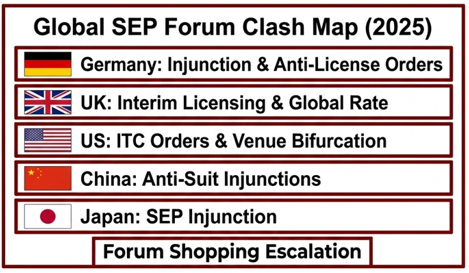
- SEP litigation has become a battleground, with German and Unified Patent Court judges granting injunctions while UK courts push interim licensing.
- In September 2025, European courts introduced anti‑interim‑license injunctions, escalating jurisdictional tensions and cross‑border conflicts.
- The automotive sector is the next SEP hotspot, as connected vehicles strain smartphone‑based licensing models across complex supply chains.
Introduction
The FRAND licensing framework was created to ensure fair access to technologies protected by standard essential patents (SEPs). When a patent becomes necessary to implement systems such as 5G patent licensing technologies or Wi‑Fi, the owner commits to license it on fair, reasonable, and non‑discriminatory terms to prevent monopolistic abuse. By 2025, the framework faces severe pressure. Legal certainty has been replaced by cross-border SEP litigation across competing jurisdictions. Recent court decisions and regulatory actions suggest structural breakdown rather than gradual refinement. This article explores the growing challenges, regional conflicts, valuation disputes, and industry‑specific pressures that are reshaping the global FRAND licensing landscape.
Europe’s Failed Harmonization and the Jurisdictional Vacuum
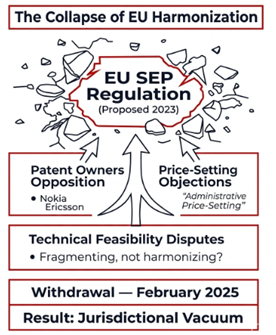
In February 2025, the European Commission withdrew its proposed SEP regulatory framework. The plan, introduced in April 2023, aimed to give the European Union Intellectual Property Office authority over SEP registration and SEP essentiality checks, and royalty recommendations. It also included mandatory pre‑litigation conciliation that would temporarily suspend injunction rights. The withdrawal, citing no foreseeable agreement among stakeholders, exposed deep tensions. Patent owners such as Nokia and Ericsson opposed what they saw as administrative price‑setting that would reduce telecom patent licensing revenues. Institutions including the European Patent Office, the Unified Patent Court, and ETSI raised concerns about jurisdictional overlap, technical feasibility, and risks of fragmentation. The collapse leaves Europe without a unified SEP framework at a time of rising litigation. The United Kingdom has moved to fill the gap. It launched a consultation on SEP licensing and litigation efficiency, signaling its intent to position British courts as preferred venues for global rate‑setting disputes.
China’s Rise and the WTO’s Intervention
China’s courts have emerged as aggressive players in the global SEP disputes. They assert authority to set global FRAND licensing rates and issue SEP anti‑suit injunctions to block litigation in other jurisdictions. In 2023, the Chongqing court in Nokia v Oppo set global licensing rates for a multinational SEP portfolio covering 4G and 5G technologies. This marked the first time a Chinese court established worldwide terms. China’s approach reflects its shift from net technology licensee to emerging licensor. Companies such as Huawei, ZTE, Xiaomi, and OPPO have invested heavily in 5G research. By October 2025, more than 66,000 active 5G patent families were granted worldwide, with Chinese firms holding a large share. On July 21, 2025, the World Trade Organization issued a major ruling. WTO arbitrators found that China’s anti‑suit injunction policy violated the TRIPS Agreement, including Articles 1.1, 28.1, 28.2, and transparency obligations under Article 63. The panel rejected China’s claim that these were isolated orders. It concluded they represented a general state policy that prevented patent holders from enforcing rights abroad.
Unified Patent Court Approach to FRAND Disputes
The Unified Patent Court issued its first major SEP litigation decision on November 22, 2024 in Panasonic v. Oppo. The Mannheim Local Division granted an injunction after finding the defendant failed to negotiate in good faith FRAND negotiations. The analytical framework was more significant than the outcome. The Mannheim division rejected the European Commission’s preference for strict sequential use of the Huawei v ZTE framework. It adopted the flexible German approach that emphasizes party behavior over rigid procedure. This favors patent owners by lowering barriers to injunctions and places heavier good‑faith obligations on implementers. Practical effects followed quickly. In September 2025, the Munich Regional Court and the UPC Mannheim Division issued anti‑interim‑license injunctions against Amazon. These orders blocked Amazon from seeking interim license declarations in the United Kingdom. The rulings created direct judicial conflict, as compliance with a UK order could simultaneously violate a German or UPC order.
United States Fragmentation and Active Enforcement
The United States has no centralized SEP policy. Cases are decided individually by the International Trade Commission and federal district courts. Recent ITC rulings confirm exclusion orders remain available for SEP complaints. In the Ericsson v Lenovo case involving 5G patents, investigators recommended a limited exclusion order. They rejected claims that FRAND commitments block such relief. The ITC has refused to delay proceedings for parallel rate‑setting cases abroad. It reasoned that delays would encourage forum shopping by implementers. Federal courts in Texas and Delaware have become leading venues. Judges there are testing bifurcated trials that set licensing terms before ruling on technical infringement.
Valuation Warfare and Injunction Divergence
Beneath jurisdictional conflicts lie deep disagreements on how to comparable licenses approach to FRAND rate setting. The comparable licenses approach relies on existing agreements to set market‑based rates. The top‑down SEP royalty allocation method begins with the total royalty burden and allocates shares proportionally. Chinese courts prefer patent counting while rejecting qualitative essentiality analysis. The stakes are high. The global 5G licensing market is valued at about 15 billion dollars annually. A single percentage‑point shift in portfolio shares equals roughly 151 million dollars in royalty value. Patent data accuracy is critical. LexisNexis found an 18 percent error rate in ETSI declarations, creating valuation drift of 136 to 272 million dollars per year for licensors with 5 to 10 percent portfolio shares. Injunctions now drive litigation strategy. German courts and the UPC grant injunctions when implementers fail good‑faith obligations. Japan issued its first SEP injunction in June 2025 when the Tokyo District Court ruled against Google in the Pantech case, finding Google acted as an unwilling licensee by withholding transparent disclosure during negotiations.
Automotive Sector Exposes Framework Limitations
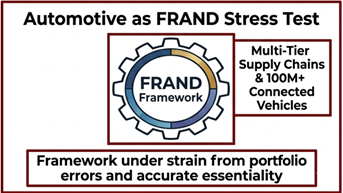
Connected vehicle patents is now the proving ground for the FRAND framework. Litigation has expanded as Nokia, IP Bridge, and Huawei pursue actions against vehicle manufacturers over cellular and Wi‑Fi patents. Manufacturers argue automotive SEP licensing at component level. Patent owners counter that full consumer value comes from connectivity features. The Avanci patent pool licensing offers per‑vehicle licensing at standardized rates. By 2025, more than 80 brands covering 100 million connected vehicles had taken licenses. Automotive disputes reveal the framework’s limits. Multi‑tier licensing, valuation of purchased components, and market segmentation issues show how standards built for one industry become essential in another.
Wrapping Up
Evidence from 2024 and 2025 shows the global SEP licensing framework under strain. The EU withdrew its SEP regulation. The WTO ruled against China’s anti‑suit injunctions. Courts issued anti‑interim‑license measures. Automotive disputes added new pressure. Together, these highlight a system driven by unilateral action and forum shopping instead of cooperative negotiation. This fragmentation raises cross border SEP disputes. It creates overlapping proceedings and conflicting court orders. It weakens incentives for good‑faith licensing. Whether this is a structural breakdown or a new equilibrium remains uncertain. The next 24 to 36 months will be decisive in showing if jurisdictions align on core principles or drift into fragmented regional regimes.
Recommendations for Stakeholders
- Patent Owners and Licensors
- Abandon single‑jurisdiction enforcement strategies in favor of coordinated multi‑forum filings.
- Invest in verified patent data and rigorous portfolio analysis to strengthen negotiating positions.
- Implementers and Technology Adopters
- Engage early in good faith negotiations instead of relying on delay tactics.
- Maintain detailed records of conduct, product volumes, and responses to licensing proposals.
- Policymakers and Regulatory Authorities
- Prioritize international coordination on core principles even if comprehensive harmonization proves unattainable.
- Focus on good‑faith negotiation requirements and injunction standards rather than rate‑setting frameworks.
- Standard Development Organizations
- Enhance clarity in IP policies with stricter disclosure requirements and consequences for over‑declaration.
- Provide binding arbitration as a neutral alternative to litigation.
- Legal and Compliance Teams
- Develop proactive strategies to manage cross‑border litigation risks.
- Monitor evolving jurisdictional rules to ensure compliance and reduce exposure to conflicting court orders.