

Connected Cars and SEP Licensing: Why Automotive Patent Enforcement Is Surging?
Connected cars ignite a high-stakes global battle over SEP enforcement in automotive markets
Key Takeaways
- The automotive sector is now the fastest-growing arena for SEP enforcement and automotive patent litigation.
- OEM‑level licensing has replaced supplier models, reshaping supply chain economics.
- Patent pools improve efficiency but concentrate pricing power through per‑vehicle royalties.
- Jurisdiction is fragmented, with EU courts expanding authority and FRAND standards inconsistent.
- Rising SEP costs from V2X, OTA, and infotainment threaten margins without fair apportionment.
Introduction
Vehicles are becoming platforms within the connected vehicle ecosystem. This shift exposes automakers to a patent ecosystem dominated by connected car patents and telecom licensing once limited to telecom and consumer electronics. By 2025, over 400 million connected cars will be on the road. Each car will include telematics units, infotainment systems, and other automotive connectivity technologies, and cellular modules. These features rely on hundreds of automotive connectivity patents and standard essential patents (SEP). The patents cover 2G to 5G, Wi-Fi, and emerging V2X communication standards. This convergence has created tension between automotive supply chains and telecom licensing. For decades, OEMs relied on component-level licenses through Tier-1 suppliers. Royalties were calculated on supplier sale prices. Telecom companies increasingly rely on telecom patent licensing strategies. They argue connectivity adds value at the vehicle level and demand higher SEP royalty rates based on car retail prices.
The V2X communication technology market is valued at $4.1 billion in 2024 and projected to grow 25% annually through 2034. Over-the-air (OTA) updates add another $4.78 billion in 2025, with forecasts of $11.23 billion by 2030. Each layer introduces new SEP royalty exposure and licensing costs. U.S. SEP case filings rose from 118 in 2014 to 223 in 2024, with Patent Assertion Entities driving over 40% of disputes. in this study, we will examine licensing conflicts in automotive supply chains, patent pools and the FRAND determination challenge, litigation hotspots and forum dynamics, and strategic implications for industry stakeholders.
Licensing conflicts in automotive supply chain licensing are becoming more common
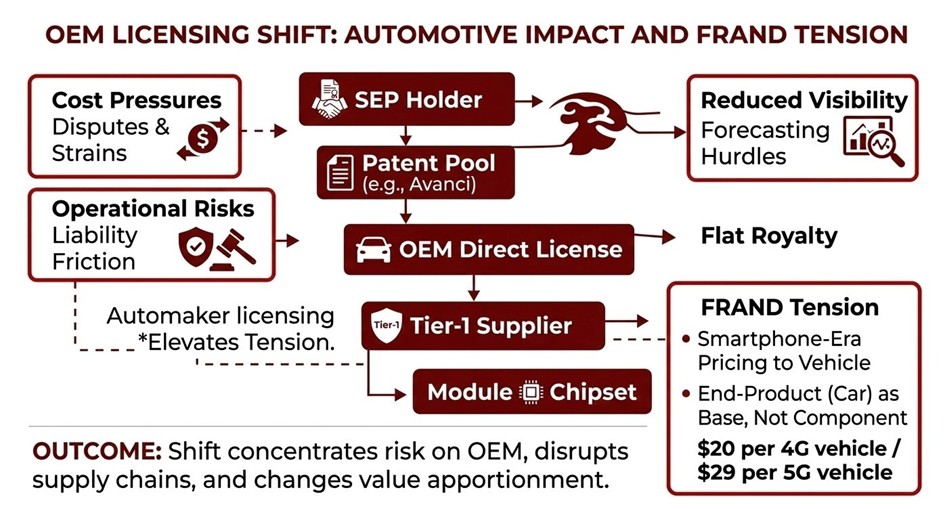
The Continental v. Avanci case showed the clear disconnect between automotive supply chains and telecom licensing. Continental, a major Tier-1 supplier that provides telematics modules to several OEMs, argued that Avanci’s refusal to offer component-level licenses was anticompetitive and violated FRAND commitments. The Fifth Circuit dismissed the claim on antitrust standing grounds. This effectively confirmed OEM-only licensing but left open questions about how costs and liability should be shared within supply chains. This ruling has serious operational effects. When an OEM pays $20 to $29 per vehicle for a license, it usually tries to recover these costs from suppliers through price adjustments or indemnification clauses. Suppliers, however, struggle with essential patent validation and transparency in their components. They cannot verify if the licensed portfolio justifies the fees. This lack of transparency creates friction in patent portfolio licensing negotiations and exposes both sides to disputes over cost allocation. The Nokia v. Daimler settlement in 2021 was another turning point. German courts issued injunctions that blocked Mercedes sales. Daimler eventually accepted a direct license on confidential terms. This case sent a strong signal to the industry: resisting OEM-level licensing could lead to severe commercial consequences, especially in Europe where courts are more willing to grant injunctions than in the U.S.
Patent Pools and the FRAND Determination Challenge
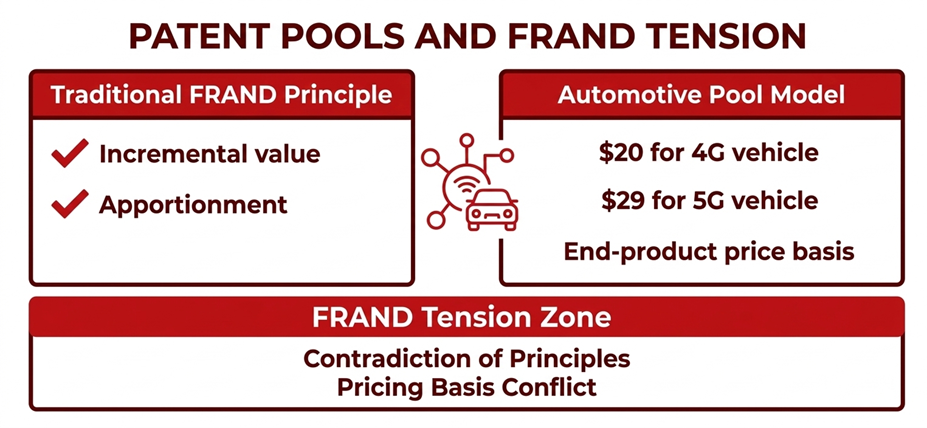
Patent pools licensing have become the main way to handle licensing. Avanci now plays a central role in global SEP licensing for connected cars. The pool model makes licensing easier by bundling patents from many holders into one deal. This improves patent monetization strategies for SEP holders. Avanci now controls about 80% of 4G essential patents. The company charges $20 per vehicle for 4G and $29 for 5G.
This level of control raises questions about whether setting rates unilaterally meets FRAND obligations. Courts reviewing FRAND licensing royalties have stressed that rates should reflect the added value of the technology, not the overall product price. In Microsoft Corp. v. Motorola case, the court rejected royalties based on the full product value. It insisted on apportionment to isolate the technology’s contribution. Applied to cars, this means connectivity in a $50,000 vehicle should not cost more than the same feature in a $500 smartphone simply because the car is more expensive.
Yet Avanci’s per-vehicle pricing uses the car itself as the royalty base. Cellular connectivity is only a small part of the vehicle’s value and cost. Legal analysis from Berkeley Technology Law Journal points out that applying smartphone royalty models to cars without adjusting for economic reality goes against FRAND principles established in earlier cases. The automotive industry also runs on much lower profit margins than consumer electronics. This makes cumulative licensing costs a bigger threat to commercial viability.
Litigation Hotspots and Forum Dynamics
The Eastern District of Texas remains a hotspot for global SEP litigation for automotive patent disputes. Judge Rodney Gilstrap has overseen many cases involving the automotive industry. At the same time, European courts have started claiming jurisdiction over U.S. patents held by companies with EU offices. The CJEU’s BSH Hausgeräte GmbH v. Electrolux AB ruling showed this trend. It allows SEP holders to run patent enforcement strategies in one forum, which increases pressure on implementers. The U.S. Department of Justice has also signaled a shift toward supporting patent owners. It filed statements saying that owning a patent does not automatically mean market power, and that injunctions can be appropriate even for non-practicing entities. These signals may encourage SEP holders to take a more aggressive approach, especially as the connected car market grows from $51.56 billion in 2025 to $181.90 billion by 2034. UK courts have recently shown they are willing to set global FRAND rates. German courts, meanwhile, have issued anti-suit injunctions to stop implementers from seeking temporary licenses in UK proceedings. This fragmented legal landscape creates opportunities for patent holders, as forum shopping affects jurisdiction in SEP litigation. It also forces automakers to defend themselves in multiple jurisdictions at the same time.
Strategic Implications for Industry Stakeholders
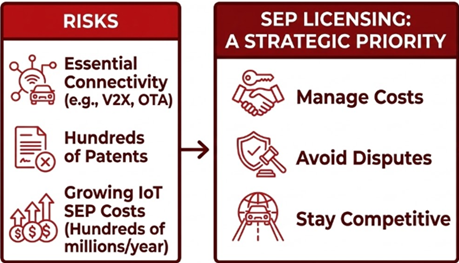
The automotive SEP landscape is a major challenge for the industry. Companies must balance innovation with rising licensing costs. Connectivity features rely heavily on automotive IoT connectivity are now essential but add expose automakers to hundreds of connected car patents. Automotive is the largest segment in IoT SEP licensing, with revenues already in the hundreds of millions each year. As connected cars grow, these costs will rise further, managing automotive SEP licensing is now a strategic priority. Strong portfolio management, proactive negotiations are essential as telecom and automotive convergence accelerates, and clear supply chain agreements are needed to control risks. Firms that treat SEP licensing as a core strategy will be better positioned to manage costs, avoid disputes, and stay competitive in a market where connectivity is central to vehicle value.
Wrapping Up
The connected car market is reaching a turning point. connectivity is central to automotive digital transformation are controlled by patent portfolios, the shift creates cross-industry patent conflicts. The move from supplier-level to OEM-level licensing has been confirmed legally but remains disputed in practice, especially around royalty bases and cost sharing. Patent pools bring efficiency by bundling licenses, but they also concentrate pricing power. This raises questions about whether they meet FRAND obligations, since automotive economics differ greatly from telecom. As V2X, OTA updates, and advanced infotainment systems expand, SEP royalty rates risk cutting deeply into margins. Courts and regulators will need to create fairer apportionment methods that reflect the added value of each technology rather than the full vehicle price. Industry stakeholders must balance defensive litigation with the need to resolve licensing obligations in a predictable and efficient way. Those who manage SEP exposure strategically will be better positioned to protect margins and remain competitive in a market where connectivity is now central to vehicle value.
Recommendations for Stakeholders
- For Automotive OEMs: Build SEP management teams across legal, procurement, and engineering. Centralize licensing oversight, review essential patents, and align supplier indemnification with technical responsibility.
- For Tier-1 Suppliers: Set SEP licensing terms clearly in OEM contracts. Keep documentation linking patents to components, and join industry groups that support component-level licensing.
- For Patent Holders and Licensing Entities: Use transparent, AI-driven essentiality checks. Clarify royalty calculations, define apportionment methods, and engage early with automotive associations to reduce disputes.
- For Policymakers and Standards Bodies: Give clear guidance on licensing levels. Require disclosure of total royalty burdens during standard setting, and explore FRAND frameworks tailored to automotive economics.
- For Industry Consortia and Alliances: Encourage dialogue between automotive and telecom sectors. Share best practices for fair licensing, and create common frameworks to reduce litigation and improve transparency.