
Tracing Mondelēz’s decade-long shift from indulgence-led growth to mindful, better-for-you snacking.
Key Takeaways
- Mondelēz has invested over $4 billion across acquisitions, reformulations, and innovation to pivot from indulgence-led growth to balanced, mindful snacking.
- The company followed a phased strategy by entering BFY through acquisitions first, then scaling the segment via in-house brand innovation.
- Protein bars, allergen-free foods, plant-based chocolates, and bakery are priority BFY growth pillars.
- Portion control and transparency have become central, with more than 80% of revenue now coming from individually wrapped portions or products offering clear portion guidance.
- Strategic partnerships and AI-led marketing are strengthening Mondelēz’s ability to personalize, scale, and future-proof BFY offerings.
Introduction
For decades, Mondelēz International built its dominance on indulgent, iconic brands such as Oreo, Cadbury, and Milka. However, shifting consumer expectations around health, transparency, and balance have forced global snack leaders to rethink growth strategies. The company has evolved from a traditional confectionery giant into a mindful snacking powerhouse. Through strategic investments exceeding $4 billion, the company has systematically strengthened its mindful snacking approach and now generates approximately 7% of its U.S. revenue from better-for-you snacks, based on ExpertLancing’s preliminary research [1, 2]. Additionally, more than 80% of this revenue comes from individually wrapped portions or packs with clear portion guidance, helping consumers better understand nutritional content, which is a key driver for those choosing better-for-you snacks.
The Strategic Inflection Point: From Indulgence to Mindful Snacking
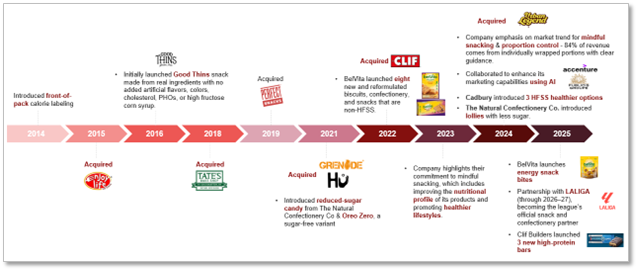
By the early 2010s, consumer snacking behavior had begun to change structurally. Shoppers increasingly demanded cleaner labels, lower sugar, functional benefits, and portion awareness without sacrificing taste. Recognizing this inflection point early, Mondelēz initiated foundational changes in 2014, introducing front-of-pack calorie labeling, signaling a commitment to transparency and informed choice.
This move set the tone for what would become a long-term transformation: not an abrupt exit from indulgence, but a rebalancing of the portfolio toward health-forward and permissible indulgence options.
Phase 1 (2015 – 2019): Acquiring Credibility Through Emerging BFY Brands
Mondelēz’s initial strategy focused on acquiring high-growth, niche BFY brands to rapidly enter new categories and consumer segments.
- 2015 – Acquisition with Enjoy Life ($81M): Marked Mondelēz’s first major BFY acquisition, giving it a strong foothold in allergen-free snacks catering to gluten-free and free-from consumers.
- 2016 – Good Thins launch: An internal innovation milestone, Good Thins positioned Mondelēz in the “real ingredients, no artificial additives” cracker space.
- 2018 – Acquisition with Tate’s Bake Shop ($500M): While indulgent, Tate’s represented a premium, clean-label positioning thereby bridging indulgence and quality.
- 2019 – Acquisition with Perfect Bar ($70M): Entry into refrigerated, organic, protein-rich snacks, signaling interest in functional nutrition and lifestyle-led consumption.
During this phase, Mondelēz primarily bought its way into BFY, leveraging startups and challenger brands to learn, test, and scale within emerging categories.
Phase 2 (2020 – 2022): Scaling Protein, Plant-Based, and Reduced-Sugar Platforms
As BFY demand accelerated, Mondelēz doubled down on protein, plant-based, and reduced-sugar offerings segments aligned with mainstream adoption.
- 2021 – Acquisition with Hu ($340M): Strengthened presence in vegan, paleo-friendly chocolates and grain-free crackers.
- 2021 – Acquisition with Grenade ($277M): Reinforced leadership in high-protein, low-sugar bars, a category with strong repeat consumption.
- 2021 – Reduced-sugar launches: Oreo Zero and reformulated candies under The Natural Confectionery Co. addressed sugar reduction without brand dilution.
- 2022 – Acquisition with Clif Bar ($2.9B): The largest BFY acquisition, positioning Mondelēz as a global leader in organic energy and performance nutrition bars.
- 2022 – BelVita: Launched eight new and reformulated biscuits, confectionery, and snacks that are non-HFSS.
By this stage, Mondelēz had moved beyond experimentation. The company now controlled scaled BFY platforms with global expansion potential.
Phase 3 (2023 – 2025): Internal Innovation, Portion Control, and Digital Enablement
Post-2022, Mondelēz’s strategy evolved again, from acquisition-led growth to organic expansion within its own brands.
- 2023 – Mindful Snacking Commitment: Company highlighted their commitment to mindful snacking, which includes improving the nutritional profile of its products and promoting healthier lifestyles.
- 2024 – Portion Control Leadership: Company emphasized on market trend for mindful snacking & proportion control – 84% of revenue comes from individually wrapped portions with clear guidance.
- 2024 – Brand-Led BFY Expansion: BelVita energy snack bites, Cadbury HFSS-compliant options, and Clif Builders high-protein extensions.
- 2024 – Acquisition with Urban Legend: A BFY doughnut and pastry brand, signaling entry into better-for-you bakery.
- 2024 – Digital & AI Partnerships: Collaboration with Accenture and Publicis Groupe to deploy AI across marketing, personalization, and consumer engagement.
- 2025 – Sports & Lifestyle Alignment: Partnership with LaLiga reinforces active-lifestyle positioning.
- 2025 – BelVita Launches Energy Snack Bites: Launched snack bites in banana dark chocolate & sunflower seed, and blueberry & sunflower seed flavors.
- 2025 – New Lauch: Clif Builders launched 3 new high-protein bars. It launched in two flavors including BUILDERS OREO-flavored and BUILDERS Reduced Sugar Crispy Protein bars.
CEO Dirk Van de Put has consistently highlighted innovation through healthier variants such as Oreo Zero Sugar in China and gluten-free Oreos in the U.S. while noting the growing role of D2C and eCommerce, where basket sizes are larger and BFY discovery is faster.
A Clear Strategic Pattern Emerges
Mondelēz’s BFY journey reveals a structured pattern:
- Acquire to enter (startups and niche brands for speed and credibility).
- Scale through core brands (BelVita, Cadbury, Oreo, Clif).
- Balance indulgence with portion control, not elimination.
- Use digital and AI to personalize and optimize BFY engagement.
- Expand adjacencies, from bars to bakery and functional snacking.
Notably, protein bars have remained a central focus, while the move into BFY bakery reflects confidence in extending health-led positioning into traditionally indulgent categories.
Conclusion
Mondelēz International’s investment of over $4 billion in the Better-For-You snacking market represents one of the most pivotal strategic changes made by any company within the present context of the food industry. Using both the strategy of making large-scale acquisitions of industry-leading brands (such as Clif, Hu, Grenade) as well as the ability to use its core brands (Oreo and Cadbury) for innovation, Mondelēz International has been able to navigate through the rise of mindful consumption. Together, these strategies are supported by portion control and advancing digital technology to create a leading position in the Better For You sector while establishing an exciting, sustainable business model that balances indulgence with health and wellness.
Recommendations for Stakeholders
- C-Suite Leaders: Look beyond short-term margin pressures and commit to long-term portfolio rebalancing. Mondelēz’s phased $4B+ investment demonstrates how sustained capital allocation, clearly defined nutrition-linked growth ambitions, and disciplined execution can collectively build durable leadership in better-for-you snacking.
- Brand Teams: Shift the focus from products alone to the role snacks play in everyday lifestyles. Communicating mindful snacking, portion guidance, and functional benefits supported by AI-enabled personalization that helps strengthen consumer trust, deepen engagement, and drive repeat purchase.
- R&D Teams: Balance breakthrough innovation with smarter evolution of existing power brands. Reformulating and extending trusted brands such as BelVita and Cadbury into better-for-you spaces can accelerate consumer acceptance while effectively managing development risk and cost.
- Strategy & M&A: View acquisitions as a way to build capabilities, not just scale revenues. Prioritizing brands with differentiated nutrition science, protein expertise, or new consumption occasions especially in fast-growing segments like protein bars and better-for-you bakery that can unlock long-term strategic value.
- Retail Partners: Create clearer pathways for consumers to discover better-for-you choices. Curated assortments, portion-led merchandising, and strong digital visibility can lift basket sizes and loyalty, particularly as online grocery and D2C channels continue to gain momentum.