

Open Source and Standard Essential Patents: The Growing Collision
The Collision Between Open Source Software and Standard Essential Patents
Key Takeaways
- Open source software increasingly faces standard essential patent risks across wireless codecs and connectivity standards.
- Linux implementations using IEEE 802.11 wireless standards create conflicts between SEP licensing obligations and GPL terms.
- Patent pools demand royalties on so‑called royalty free codecs. Sisvel charges EUR 0.32 per device for AV1 and targets VP9.
- FRAND licensing terms often clash with open source licensing rules, triggering GPL patent conflict restrictions.
- Devices automotive and streaming platforms face hidden open source patent risks across legal engineering and procurement silos.
Introduction
Standard essential patents (SEPs) form the backbone of modern technology standards. They are required to implement global standards and licensed under FRAND terms to balance innovation and access. Networks from 2G to 5G and Wi Fi depend on thousands of these patents.
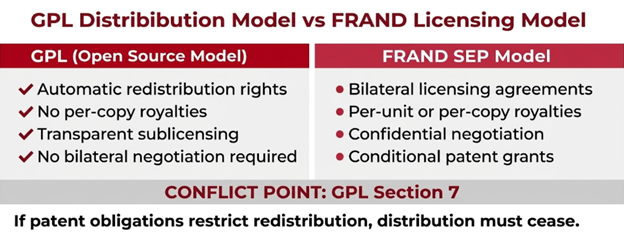
Open source licenses grant automatic rights to use, modify, and distribute software. FRAND licensing demands negotiations and royalties. This creates direct conflict. GPL version 2 Section 7 prohibits distribution if patent obligations restrict royalty free use.
In this study we will explore how open source software faces growing conflicts with standard essential patents. SEP licensing frameworks and FRAND terms challenge the traditional freedoms of open source models. This tension impacts wireless standards codecs automotive systems and streaming platforms.
Linux in the Wireless World
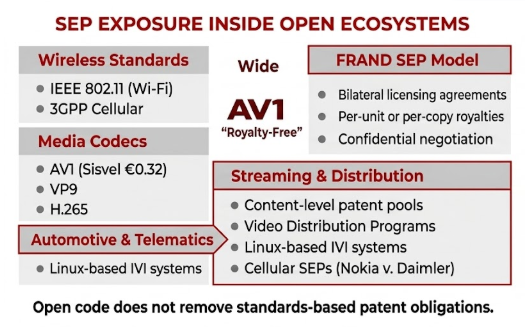
The Linux kernel powers billions of devices, from smartphones to servers to automotive telematics units. Many of these implementations incorporate wireless connectivity through IEEE 802.11 standards, exposing them to a complex SEP landscape. Patent pools like 6’s Wi-Fi/WLAN program license patents essential to Wi-Fi standards, while IPWatchdog reports Wi-Fi 6 SEP licensing represents a $10 billion royalty market with litigation rising sharply.
Device manufacturers usually manage Wi-Fi patent licensing at the hardware level. The challenge grows when open source software directly implements wireless protocols. Linux wireless drivers maintained in the kernel follow standards governed by FRAND-encumbered SEPs. Distributors face a legal paradox. Obtaining individual patent licenses contradicts GPL distribution terms. Ignoring SEP obligations risks infringement claims.
The automotive sector shows this collision clearly. Modern vehicles rely on Linux-based telematics systems with cellular connectivity, for navigation entertainment and communication. The Nokia v Daimler litigation highlighted disputes over whether car makers or suppliers must license cellular SEPs for 2G 3G and 4G standards.
Continental Automotive Systems accused Nokia of demanding non FRAND rates and targeting customers with litigation threats while refusing direct FRAND licenses to suppliers. These disputes reveal how SEP licensing conflicts spread across supply chains. Companies integrating open source software into connected devices often face hidden patent exposure without realizing the risks.
The Open Codec Illusion
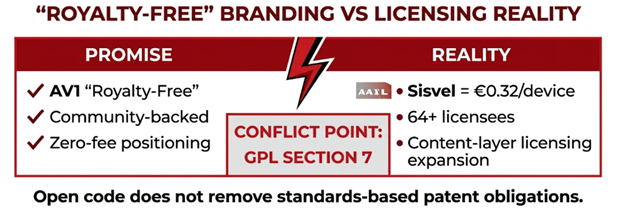
The promise of royalty-free video codecs has attracted major investment, yet patent pools increasingly target implementations despite open branding. The Alliance for Open Media introduced AV1 as a royalty free alternative to proprietary codecs such as H.265. Backed by leading technology firms, AV1 was promoted with a zero-royalty licensing policy.
Sisvel challenges this model by operating a patent pool claiming coverage for AV1 implementations. It charges EUR 0.32 per display device and EUR 0.11 per non display device under its VP9 and AV1 program. More than 60 licensees are reported. This shows how codec patent licensing is no longer limited to proprietary formats.
Enforcement has expanded beyond devices to the content layer. Pools such as Avanci Video and Access Advance demand royalties from streaming services using codecs including H.265 H.266 VP9 AV1 and MPEG DASH. This applies even when device side payments are already made.
This shift from device level to content level licensing changes the risk profile for streaming platforms that rely on open source AV1 tools. Unexpected royalty exposure can reduce bandwidth savings and increase costs. Smaller operators with limited negotiating power face greater challenges. Public companies must also disclose potential liabilities in financial reports due to limited transparency in FRAND licensing terms.
Compliance Blind Spots
Tensions between open source and standard essential patents continue because responsibility is divided across functions. Legal teams manage SEP licensing but often lack technical visibility into implementations that trigger these patents. Engineering teams focus on performance and adoption without fully assessing open source patent risks. Procurement negotiates contracts but may not connect sourcing decisions to downstream SEP licensing conflicts.
These silos create compliance blind spots. An open source media server can trigger content level codec patent licensing. Automotive telematics modules may expose cellular SEP obligations. Wireless stacks can carry unaddressed Wi-Fi SEP licensing risks.
The Open Source Initiative has argued for SEP exemptions, stating that bilateral FRAND licensing terms and NDAs undermine open source licensing compliance. However, standards bodies maintain that FRAND licensing terms are technology neutral. The European Commission’s 2023 SEP proposal introduced transparency measures such as registration and essentiality checks but did not create open source carve outs.
As a result, organizations using open source in connected devices must conduct SEP risk assessments. Few companies have structured processes to map standards patents, evaluate GPL patent conflict issues, and allocate liability across supply chains. Without these measures, patent exposure in open source implementations remains a significant legal and operational risk.
Final Strategic Takeaways
The clash between SEPs and open source is structural. Patent holders seek revenue. Open source depends on frictionless distribution. As SEPs expand across wireless, media, and connectivity standards, the risks grow. Open source adoption is no longer just a licensing issue. Devices, streaming platforms, and automotive systems all face SEP exposure. Companies must align legal engineering and procurement to manage risks.
Recommendations for Stakeholders
- Engineering Teams
- Map open source dependencies to technical standards such as IEEE, ETSI, and 3GPP to identify standard essential patents.
- Check SEP declarations to avoid open source patent risk and SEP licensing conflicts.
- Review Wi Fi SEP licensing and codec patent licensing obligations before adopting new architectures.
- Legal and Compliance Functions
- Assess GPL Section 7 restrictions to prevent GPL patent conflict in open source implementations.
- Evaluate FRAND licensing terms and their compatibility with open source licensing compliance.
- Build frameworks to manage SEP licensing risks in connected devices and streaming platforms.
- Procurement and Supply Chain Management
- Clarify SEP licensing responsibility in supplier and customer contracts across multi tier supply chains.
- Ensure sourcing decisions account for standards patents and FRAND licensing obligations.
- Prevent hidden patent exposure in open source implementations across automotive and wireless systems.
- Executive Leadership
- Integrate open source and patent risks into technology planning and financial strategy.
- Recognize that even “royalty free” standards may involve SEP licensing conflicts.
- Allocate reserves for potential codec patent licensing costs and SEP licensing in connected devices.
- Product and Innovation Teams
- Align innovation strategies with standard essential patents and FRAND licensing requirements.
- Evaluate open source vs standard essential patents risks before adopting new technologies.
- Reduce open source legal risks and ensure compliance across wireless, automotive, and streaming platforms.