

The Resurgent Power of Patent Pools in Codecs and Connectivity
Key Takeaways
- Patent Pools lead SEP Licensing in video codecs and wireless connectivity.
- Fragmentation remains viable, as HEVC Patent Pools achieved wide adoption despite multiple pools.
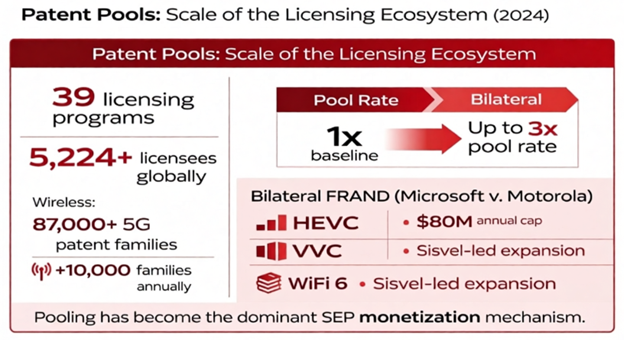
- Major Administrators run 39 programs with 5,224+ licensees worldwide (2024).
- Courts confirm bilateral SEP Licensing costs up to 3× more than pool rates, proving Collective Patent Licensing and FRAND
- Patent holders lose rate control in pools, while open standards like AV1 Royalty Free Codec challenge Codec Patent Pools, balancing licensing economics, revenue, and adoption risks.
Introduction
Patent licensing is at a crossroads. In wireless, 5G Patent Licensing has surged past 87,000 declared families by late 2024, growing by more than 10,000 annually. At the same time, Patent Pools in Video Codecs and Connectivity are expanding rapidly. While MPEG‑2 was unified under a single pool, HEVC became fragmented, and VVC licensing is even more complex with multiple pools from Via Licensing Alliance, Access Advance, and Avanci. These developments highlight both the scale and the challenges of collective licensing in modern technology standards. In this article, we explore the economics driving pool adoption, unpack transparency benefits and their boundaries, assess the control trade‑off for patent holders, and analyze situations where pools fail implementers.
Patent Pool Licensing Economics and Adoption Trends
Pools reduce transaction costs by replacing thousands of bilateral deals with one license and also cut Royalty Stacking. Courts such as Microsoft v. Motorola confirmed bilateral FRAND Licensing can be three times higher than pool rates. Administrators like Access Advance, Via Licensing Alliance, and Sisvel generate strong Patent Licensing Revenue. Despite Patent Licensing Fragmentation, HEVC Patent Pools became the standard for 4K and HDR, proving that necessity can overcome complexity.
Transparency and Rate Structures in Patent Pools
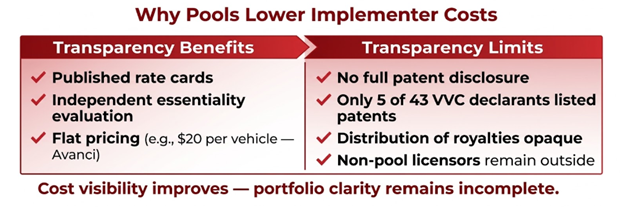
Patent Pools improve Patent Licensing Transparency by publishing Patent Pool Rate Cards and offering Patent Essentiality Evaluation. Avanci’s automotive program charges $20 per car for 4G Wireless Connectivity Patents, up from $15, giving OEMs clear visibility of costs. However, multiple pools for 5G, WiFi 6, and future Telecommunications Patent Licensing may stack fees, creating challenges for industries with lower margins. Transparency gaps remain, as few companies disclose detailed Patent Portfolio Licensing lists. For example, only five of 43 companies declaring VVC patents provided detailed lists, forcing implementers into additional bilateral negotiations.
Control Trade-Offs in SEP Licensing Models
Joining pools means patent holders lose control over pricing. Rates are uniform, limiting portfolio‑specific negotiation. In Continental v. Avanci (2022), the court upheld Avanci’s right to license directly to OEMs. With 80% coverage, implementers had no leverage and eventually accepted Avanci’s terms. Sisvel’s WiFi 6 pool shows efficiency but central control. Huawei contributes most patents, while smaller holders lose premium value in collective pricing. This highlights the trade‑off between Patent Licensing Economics and control in SEP Licensing.
When Codec Patent Pools Fail Implementers
VVC Patent Licensing is fragmented with three pools, creating complexity. Earlier cellular standards avoided pools, relying on bilateral deals despite inefficiency. Competition comes from AV1 Royalty Free Codec, which bypasses SEP Licensing Models in Telecom. Backed by Google, Amazon, Netflix, and Microsoft, AV1 pressures Codec Patent Pools to keep rates reasonable. This shows how Royalty Free Codec vs Patent Pool Licensing creates market pressure and limits aggressive pricing.
Global Impact of Patent Pools in Connectivity and 5G
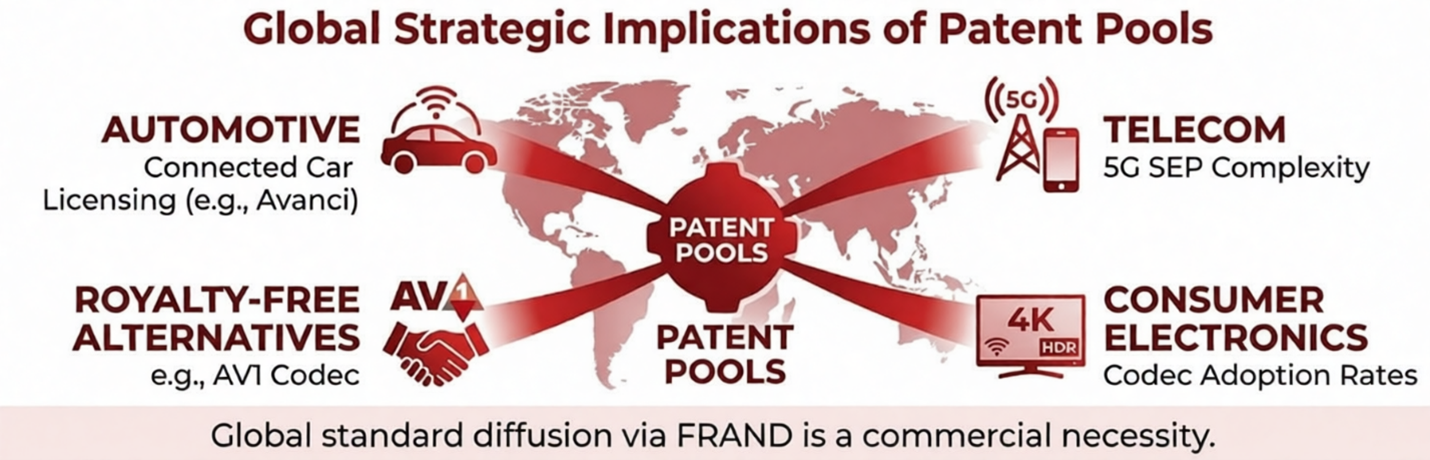
Beyond codecs and connectivity, Patent Pools in SEP Licensing are reshaping how industries approach innovation and compliance worldwide. Automotive manufacturers rely on Avanci’s collective licensing for connected cars, while telecom operators face growing complexity in 5G Patent Licensing with thousands of declared families. For consumer electronics, Codec Patent Pools determine the affordability of streaming and broadcasting technologies, directly influencing adoption rates of 4K, HDR, and next‑generation VVC. At the same time, open initiatives like the AV1 Royalty Free Codec highlight how collective licensing must balance Patent Licensing Economics with competitive pressures from royalty‑free alternatives. This industry‑wide dynamic shows that FRAND Licensing efficiency is not just a legal principle but a commercial necessity, ensuring technology diffusion while keeping costs predictable for implementers across diverse markets.
Patent Pools vs Bilateral Licensing: Future Outlook
Patent Pools vs Bilateral Licensing shows pools reduce costs, add transparency, and enable technology diffusion. However, today’s Patent Pools differ from MPEG‑2. Patent Pool Fragmentation in HEVC and VVC shows pools may multiply instead of consolidating. For implementers, multiple pools mean higher Licensing Costs of Connectivity Patents and no complete freedom to operate. The tension remains as patent holders lose negotiation flexibility, while implementers gain predictability but may overpay. This reflects the economics of Standard Essential Patent Licensing and the ongoing balance between efficiency and control. Ultimately, Patent Pools remain central to SEP Licensing in codecs and connectivity, shaping FRAND efficiency, adoption risks, and long‑term innovation.
Recommendations for Stakeholders
- Patent Holders
- Remember that once patents enter a pool, pricing control is permanently transferred to administrators.
- Compare expected pool revenue against bilateral licensing deals.
- Technology Implementers
- Request detailed patent lists, since pools may not include all standard‑essential patents.
- Demand full patent essentiality evaluations to ensure coverage.
- Standards Bodies
- Require clear disclosure before pools are formed.
- Note that fixing fragmentation later is nearly impossible.
- Competition Regulators
- Ensure collective licensing promotes competition rather than creating barriers.
- Monitor pricing practices and exclusivity terms.
- Industry‑Wide Stakeholders
- Balance efficiency, transparency, and fair market adoption to protect long‑term innovation.
- Strengthen patent pool licensing for video codecs, connectivity, and 5G.