

Streaming success now depends less on content libraries and more on video streaming optimization, efficient delivery infrastructure, and edge-based video distribution.
Key Takeaways
- Streaming advantage now comes from network efficiency and delivery performance, not content size.
- An AV1 vs H.265 codec comparison shows roughly 30% better compression, but declining CDN delivery costs reduce the financial impact of these savings.
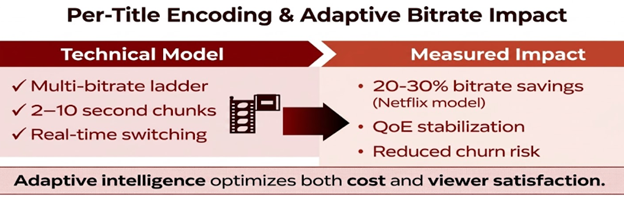
- Adaptive bitrate streaming, combined with Netflix’s per-title encoding strategy, can reduce bandwidth by 20–30% while improving viewer quality of experience (QoE).
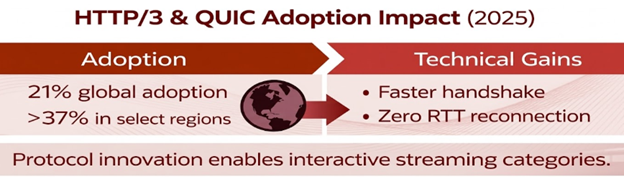
- The adoption of HTTP/3 and the QUIC protocol, now handling about 21% of global traffic, enables low-latency streaming for interactive applications.
- Edge computing, modern streaming protocols, and intelligent encoding combine to improve efficiency, making streaming architecture strategy the key differentiator.
Introduction
The next battleground in streaming is optimizing video delivery infrastructure. A combination of edge-based delivery, modern protocols such as HTTP/3 and QUIC, and intelligent encoding techniques is driving new efficiency gains, making streaming infrastructure architecture the true differentiator in streaming economics.
This study explores the codec paradox better compression diminishing returns, adaptive intelligence where network efficiency lives, protocol evolution the low latency imperative, and edge computing benefits for streaming delivery.
The Friction Between Openness and Essentiality
The streaming wars once centered on content libraries and subscriber counts. Now the contest unfolds in the infrastructure layer, where codec choices, adaptive bitrate streaming, and transport protocols now shape both operating costs and viewer satisfaction. With CDN delivery costs dropping to as low as $0.005 per gigabyte, advantage has shifted from acquiring content to streaming delivery optimization at scale.
Video Codec Efficiency: Why AV1 vs H.265 Gains Have Limits
Video codec efficiency has reached new milestones. The AV1 codec delivers roughly 38% better compression than HEVC and nearly 60% compared with H.264, while VVC promises 50 percent gains. Case studies confirm reductions of more than 40 percent in video delivery network optimization when AV1 and H.265 are deployed.
Yet adoption remains slow outside major platforms. Hardware support is limited, with fewer than 10 percent of mobile devices offering AV1 playback as of mid 2024. More importantly, with CDN pricing for video delivery as low as $0.005 per gigabyte, the incentive for bandwidth savings is far weaker than two decades ago.
Hidden costs add friction. Testing and integration require investment, transcoding adds expenses, and multiple codec versions increase storage and reduce caching efficiency. HEVC continues to dominate 4K and HDR delivery because its mature ecosystem balances compression gains with operational realities.
Adaptive Bitrate Streaming and Video Delivery Optimization
Adaptive bitrate streaming often delivers efficiency gains faster than adopting new codecs. By encoding video into multiple renditions and splitting them into short chunks, players monitor speed, buffer health, and resolution to switch seamlessly between quality levels.
Netflix pioneered per‑title encoding Netflix strategy, tailoring bitrate ladders to each video’s complexity. Simple content streams at lower bitrates, while complex scenes need more bandwidth. This approach saves 20 to 30 percent compared to fixed ladders. Context‑aware encoding further optimizes for mobile screens and 4K home theaters.
The benefits extend beyond bandwidth. Research shows adaptive streaming balances streaming delivery optimization with video streaming quality of experience QoE. Algorithms that anticipate network conditions stabilize playback, reduce oscillations, and maintain engagement. This makes adaptive streaming intelligence central to improving network efficiency.
HTTP/3, QUIC, and the Future of Low Latency Video Streaming
Transport protocols have reshaped streaming. HTTP/3, powered by the QUIC protocol, now carries roughly 21% of global internet traffic, with some regions above 37 percent. QUIC merges cryptographic and transport handshakes, speeds up connections, achieves zero round‑trip time, and avoids head‑of‑line blocking that slowed TCP.
These gains unlock new categories. WebRTC streaming delivers sub‑second latency, while HLS and DASH often exceed 10 seconds. Even low‑latency variants stay near 5 seconds. Sub‑second delivery enables interactive uses such as live betting, real‑time auctions, and collaborative video production.
QUIC fits mobile realities. It separates transport connections from IP flows, allowing smooth migration between WiFi and cellular. This supports low latency video streaming and reflects modern usage, where mobile viewing dominates and desktop consumption declines.
Edge Computing and Video Delivery Network Optimization
Edge computing is reshaping the economics of video delivery. Processing closer to users reduces latency and origin server load. Systems handle segment sizes as small as two seconds, enabling quick quality adjustments. Edge servers pre‑fetch and cache segments locally, ensuring availability without delays.
Chunked transfer encoding reduces wait times by starting transfers immediately. UDP acceleration limits packet loss that slows TCP during live events. When demand spikes, edge infrastructure scales across distributed points of presence, preventing overload.
CDN optimization techniques make this delivery model increasingly compelling. CDN pricing for video delivery varies by region, with South America and the Middle East far higher than North America or Europe. Edge caching cuts long‑haul traffic, lowering expensive routes while improving viewer experience. This highlights edge computing video delivery and strengthens streaming architecture strategy.
Final Strategic Takeaways
video streaming optimization, video codec efficiency, adaptive bitrate streaming, modern protocols such as HTTP/3 and QUIC, and edge computing. Treating video streaming network efficiency only as cost reduction misses the chance to improve video streaming quality of experience QoE, which drives retention and engagement.
Wrapping Up
The economics now favor solutions that compound benefits across multiple dimensions. Streaming delivery optimization works best when codecs, adaptive algorithms, and streaming architecture strategy are aligned. As CDN optimization for streaming continues and CDN pricing for video delivery becomes commoditized, competitive advantage depends less on content budgets and more on technical sophistication. Success will come to those who master streaming bandwidth optimization, multi‑CDN strategy for streaming platforms, and low latency streaming protocols comparison, delivering responsive and reliable experiences at scale.
Recommendations for Stakeholders
- Content Platforms
- Use adaptive bitrate streaming technology to cut bandwidth and improve video streaming quality of experience QoE.
- Prioritize per‑title encoding Netflix strategy over codec migration.
- CDN Providers
- Optimize delivery by leveraging CDN pricing for video delivery across regions.
- Implement a multi‑CDN strategy for streaming platforms.
- Application Developers
- Focus upgrades on live streaming low latency technology where sub‑second performance drives engagement.
- Adopt HTTP3 streaming benefits and QUIC protocol streaming selectively.
- Business Strategists
- Balance streaming bandwidth optimization with viewer satisfaction to protect revenue.
- Measure streaming network efficiency against retention metrics.
- Technology Leaders
- Leverage edge computing for video streaming with modern protocols and intelligent encoding.
- Build a resilient streaming architecture strategy that compounds efficiency and reliability.