
The Alibaba Patent Portfolio spans 32,474 patent families worldwide, a scale that places the company among the more prolific filers in Asian technology and commerce. Of this pool, 71.9% remain active today a figure that combines families already granted with those still pending examination — while 17,807 families have secured grant and 5,546 sit in the pipeline awaiting a decision. The grant rate across the portfolio stands at 54.8%, and a further 9,121 families have lapsed, expired or been revoked over the years. These are prosecution and maintenance metrics, and readers should not mistake them for a judgment on the quality, commercial value or enforceability of any specific patent.
Filing activity peaked in 2022, when Alibaba filed 4,185 new patent families in a single year, the highest annual figure in the portfolio’s history. Geographically, protection concentrates heavily in China, which accounts for 84.6% of filings and anchors a footprint that extends across 10 jurisdictions worldwide. On the technology side, the largest cluster sits in G06F (Digital Data Processing), covering 18,262 families and pointing to how central data-processing infrastructure remains to Alibaba’s engineering priorities.
This report treats Alibaba’s filing history as a window into where the company directs its engineering effort and legal budget, not as a scoreboard of competitive standing. Filing volume signals intent and investment, but it does not confirm that a given technology has been commercialised, licensed out, or tested in litigation. Anyone using these patterns to assess freedom-to-operate risk, licensing opportunity, or competitive threat should treat this analysis as a starting point and verify individual families independently before acting on them.
About Alibaba
Alibaba Company Profile Alibaba Group Holding Limited operates a diversified technology and commerce business headquartered in Hangzhou, China, organized around several reporting segments. The company organizes its business into Taobao and Tmall Group, Alibaba International Digital Commerce Group, Cloud Intelligence Group, Cainiao Smart Logistics Network, Local Services Group, Hujing Digital Media and Entertainment Group, and All Others. In fiscal 2026, Alibaba restructured its reporting, combining Taobao, Tmall, Ele.me and Fliggy into an Alibaba China E-commerce Group while reclassifying Cainiao, Amap and its entertainment unit into “All others.” Revenue for the six months ended September 30, 2025 was RMB495,447 million (US$69,595 million), up 3% year-over-year, or 12% on a like-for-like basis excluding disposed businesses. Cloud computing has become a central growth driver. Cloud Intelligence Group revenue jumped 38% year-over-year to RMB41,626 million in the March quarter, with AI-related products making up 30% of segment revenue and achieving triple-digit growth for eleven consecutive quarters. Its AI ecosystem spans proprietary T-Head chips, cloud infrastructure, model-as-a-service platforms and Qwen foundation models. Chairman Joe Tsai and CEO Eddie Wu have stated that the addressable market for full-stack AI providers like Alibaba is poised to grow exponentially. The company continues heavy capital investment in AI and quick commerce, which has pressured near-term profitability, while maintaining a large cash position and ongoing share buybacks. Between April and June 2026, the company bought back 13.4 million shares for US$162 million, bringing total repurchases under its long-running program to US$46.06 billion.
How Healthy is Alibaba Patent Portfolio?
The composition chart tells a fairly stable story. Granted families make up 54.8% of the portfolio, pending applications add another 17.1%, and together they push the active rate to 71.9% — a healthy share for a portfolio of this size, and one that suggests Alibaba keeps a reasonable proportion of its filings alive rather than letting them fall away by default. On the other side of the ledger, 9.9% of families have lapsed and 18.0% have been revoked, with a negligible 0.2% expired outright. The revoked share is worth watching; at nearly a fifth of the total, it points to either aggressive early-stage filing that doesn’t always survive challenge, or active portfolio pruning by the company itself, or both.
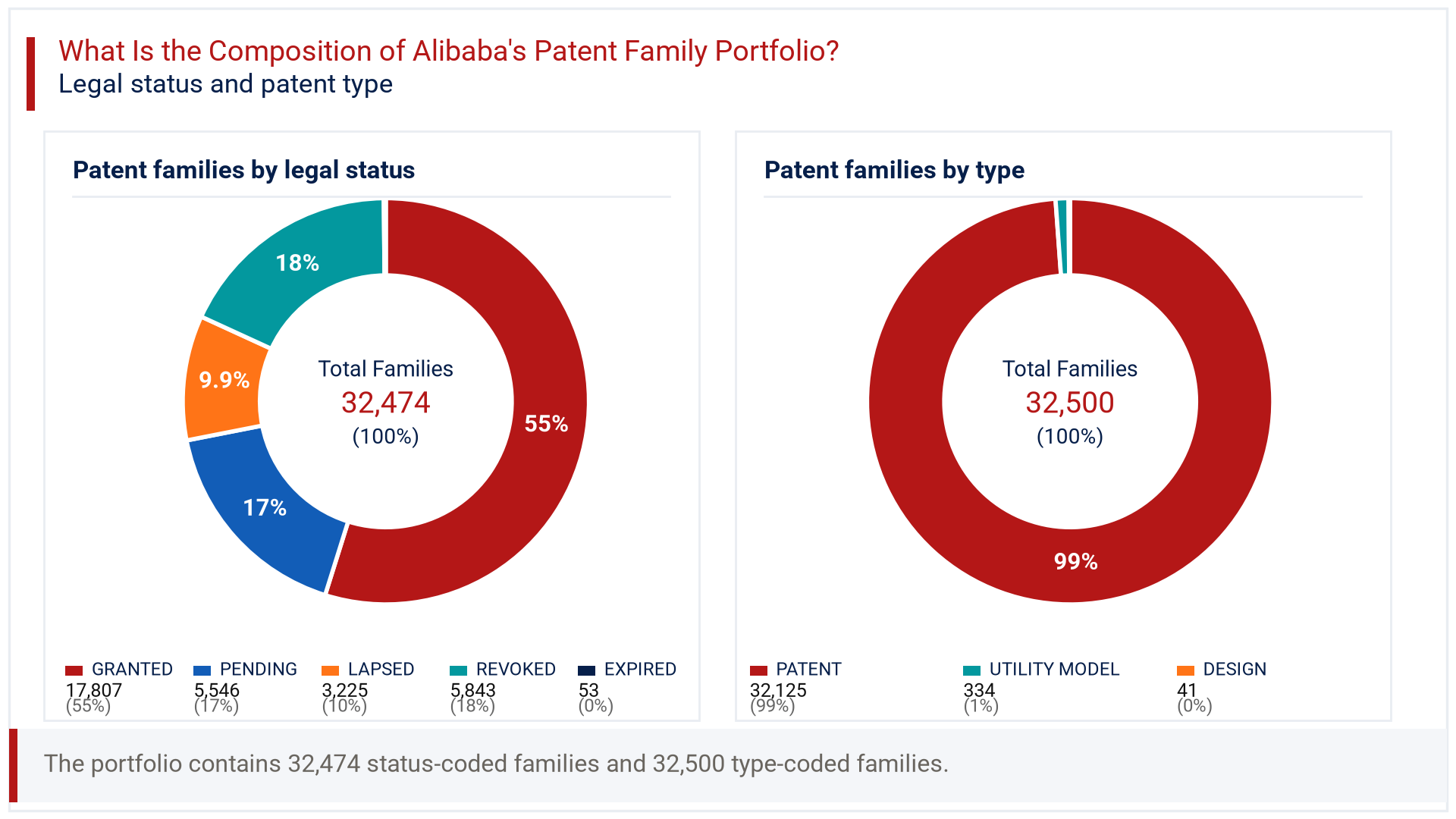
Patent type composition adds a second layer to this picture. Standard patents account for 98.8% of all families, utility models for 1.0%, and design filings for a marginal 0.1%. This is a portfolio built almost entirely around substantive technical protection rather than the faster, lighter-weight utility model or design routes that are common in Chinese filing practice for incremental improvements or product aesthetics.
Read together, these figures describe a patent portfolio health profile that is more mature than defensive-only filers, but still carries a meaningful churn rate. For a business audience, the takeaway is that Alibaba is not simply stockpiling applications — it is actively prosecuting, maintaining, and in some cases abandoning claims, which is typical behaviour for a company operating at this scale across multiple product lines.
How Has the Alibaba Patent Portfolio Evolved Over Time?
The filing-trend chart shows a portfolio that grew slowly through the 2000s, then accelerated sharply from the mid-2010s onward. Annual filings moved from 255 in the pre-2008 period to 1,351 by 2014, then climbed further to 2,274 in 2015 and 3,817 by 2018. Momentum held through the following years, with filings touching 3,118 in 2020 before hitting an all-time high of 4,185 in 2022 — a year that stands out clearly as the peak of Alibaba’s patent filing trends.
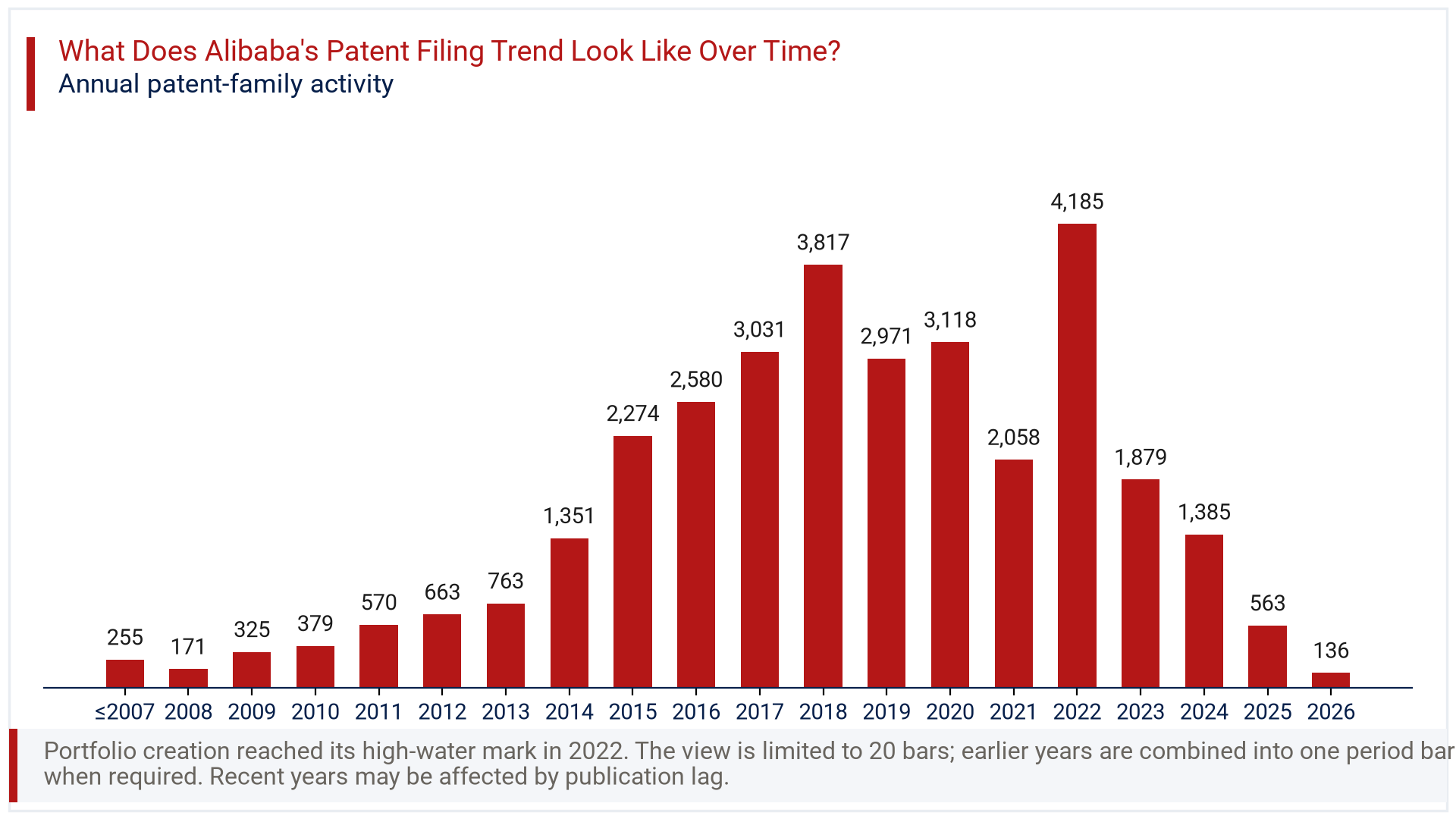
The years after the peak show a marked drop: 1,879 in 2023, 1,385 in 2024, and just 563 and 136 in 2025 and 2026 respectively, a decline of -75.8% in the most recent year measured against the year before. This steep fall should not be read as evidence that Alibaba has pulled back from filing new patents. Patent applications typically take twelve to eighteen months, and sometimes longer, to publish and appear in patent databases, so the most recent one to two years in any filing dataset will always understate real activity. The 2025 and 2026 figures are best treated as incomplete rather than declining.
What the longer trend does confirm is that Alibaba built the bulk of its current portfolio between 2014 and 2022, a period that lines up closely with its expansion into cloud infrastructure, logistics, and digital commerce technology at scale.
Where Does the Alibaba Patent Portfolio Prioritize Patent Protection?
Patent geography for Alibaba is overwhelmingly domestic. China accounts for 84.6% of all filings, by far the dominant jurisdiction, followed at a distance by filings routed through the WIPO PCT system at 20.2%, Hong Kong at 15.5%, and the United States at 13.0%. Taiwan holds 9.6%, European Patent filings sit at 6.0%, and Japan, Singapore, India and South Korea each account for shares between 2.7% and 4.9%. In absolute terms, China alone contributes 27,482 families, versus 4,224 for the United States and 942 for India.
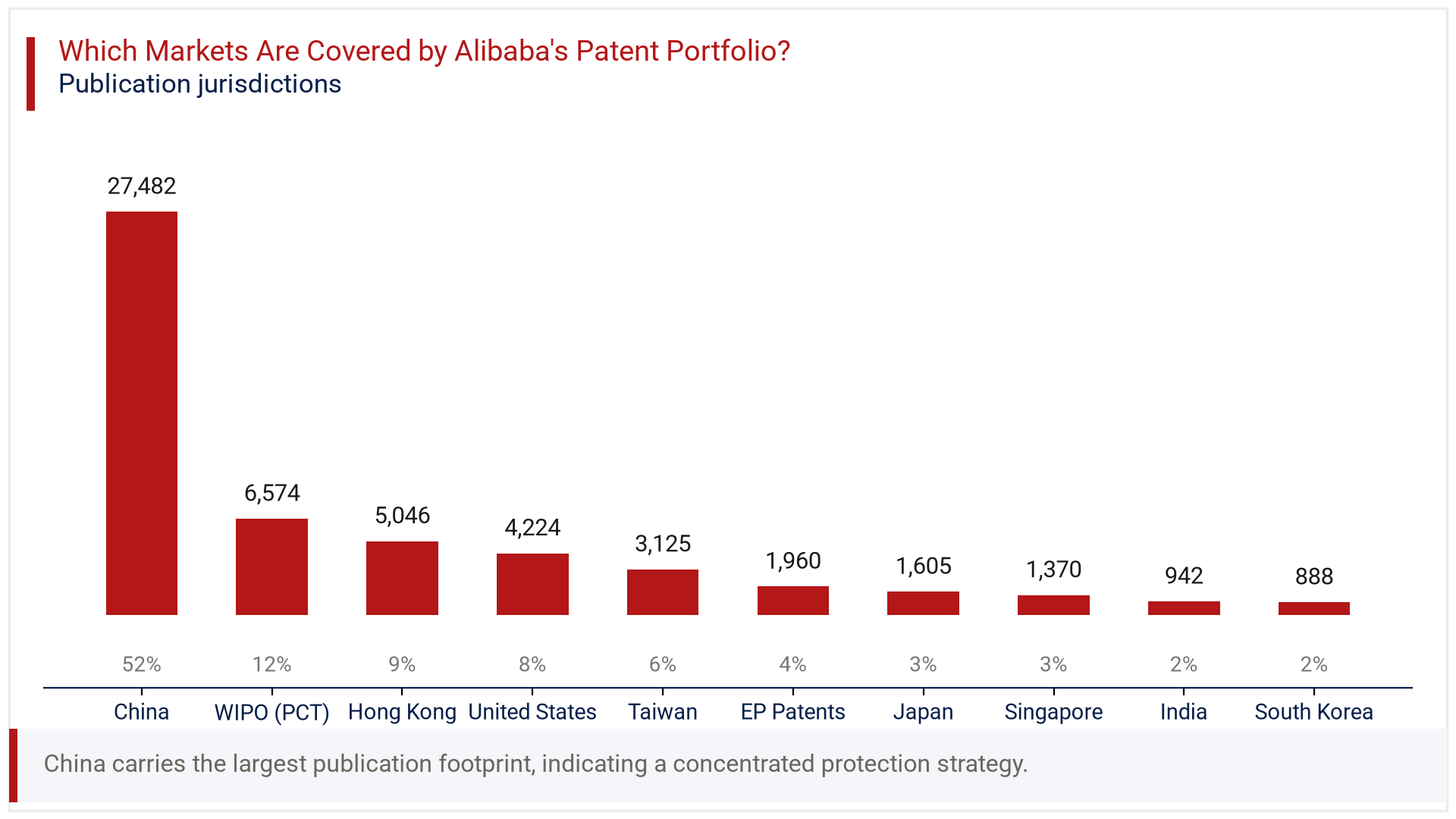
This distribution across 10 jurisdictions reflects a company whose primary commercial battleground remains China, with international filing used selectively rather than broadly. The heavy reliance on PCT applications as the second-largest category suggests Alibaba frequently keeps its international options open through a single unified filing before deciding, market by market, where to pursue national phase protection.
For competitors and partners operating outside China, this geographic concentration carries a practical implication: Alibaba’s patent protection in markets like India, South Korea or Singapore is comparatively thin, which may translate into more room to operate locally without stepping on an active Alibaba claim. Conversely, any company competing with Alibaba inside China should assume a much denser and more actively defended patent geography, given that the vast majority of the portfolio’s legal weight sits there.
Where is the Alibaba Patent Portfolio Building Protection Across Key Technologies?
The technology chart is led decisively by G06F — Digital Data Processing — which accounts for 18,262 families and 43.2% of the entire portfolio, more than three times the next largest cluster. This is followed by H04L (Digital Information Transmission) at 16.2% and 6,850 families, and G06Q (Data Processing for Administrative or Commercial Purposes) at 13.5% and 5,727 families. Together, these three clusters alone account for close to three-quarters of the portfolio.
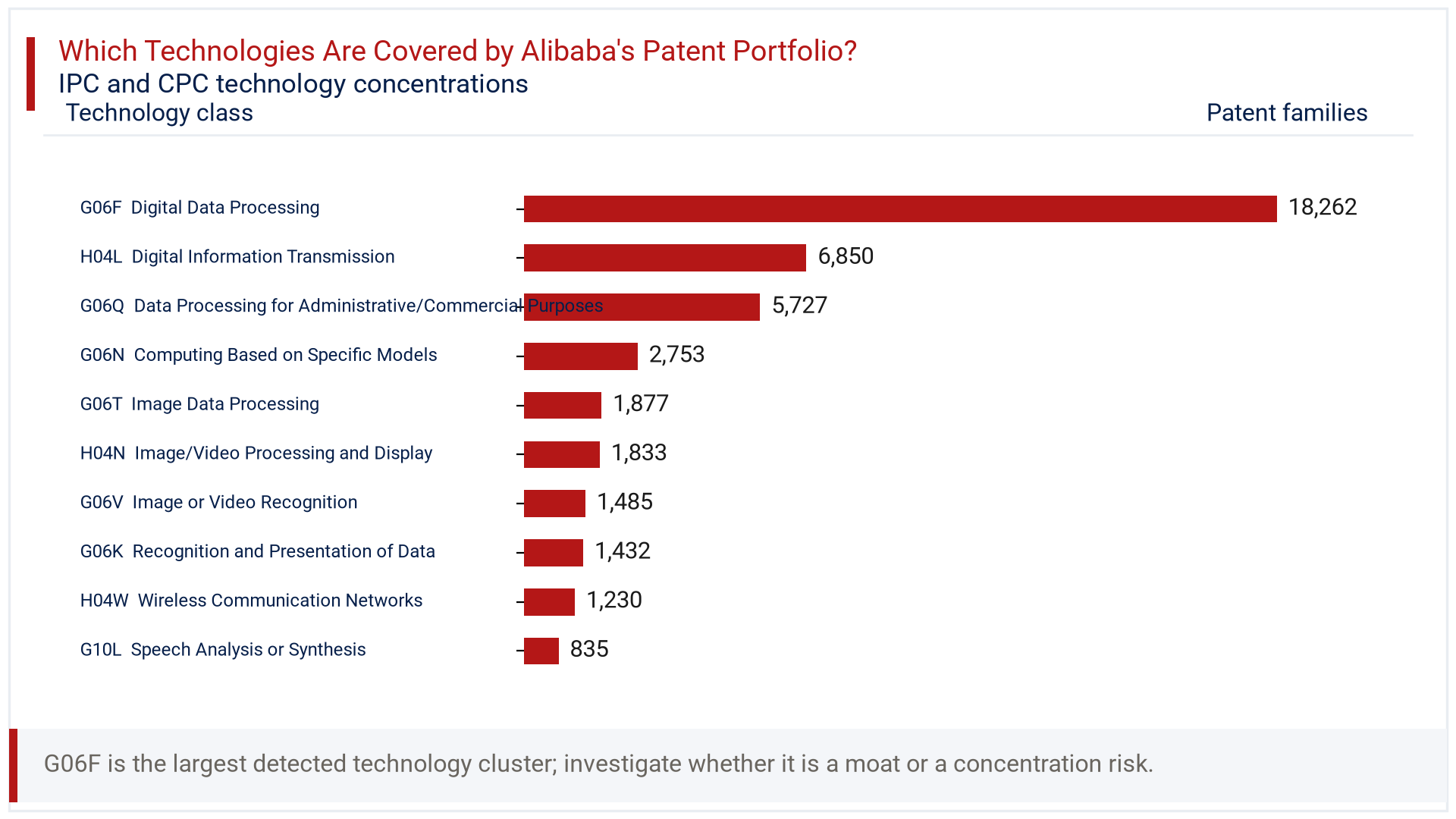
Beyond the top tier, G06N (Computing Based on Specific Models, the class most associated with machine learning methods) holds 6.5% and 2,753 families, while image and video-related classes — G06T, H04N, G06V and G06K — collectively cover a meaningful slice of filings tied to image processing, recognition and display technology. Wireless communication (H04W) and speech processing (G10L) round out the top ten with smaller but still notable shares of 2.9% and 2.0% respectively.
This IPC analysis maps closely onto Alibaba’s stated business priorities: core computing and data infrastructure dominate, transaction and commerce-related data processing forms a strong second layer, and AI-adjacent technology areas — machine learning models, image recognition, speech — appear as a consistent but smaller third tier. The pattern is consistent with a company whose patent filing behaviour tracks its cloud and AI investment closely, even if that investment shows up more prominently in recent product launches than in filing volume so far.
How Has the Alibaba Patent Portfolio Evolved Across Filing Geographies?
The heatmap of filings by year and jurisdiction shows a portfolio whose growth was never spread evenly across markets. China’s filings rose steadily from 1,169 in 2014 to a high of 3,321 in 2018, dipped through 2019 to 2021, then rebounded to 3,222 in 2022 before falling again to 1,824 in 2023 a pattern that mirrors the overall filing trend and reflects both real strategic timing and the publication lag affecting the most recent years.
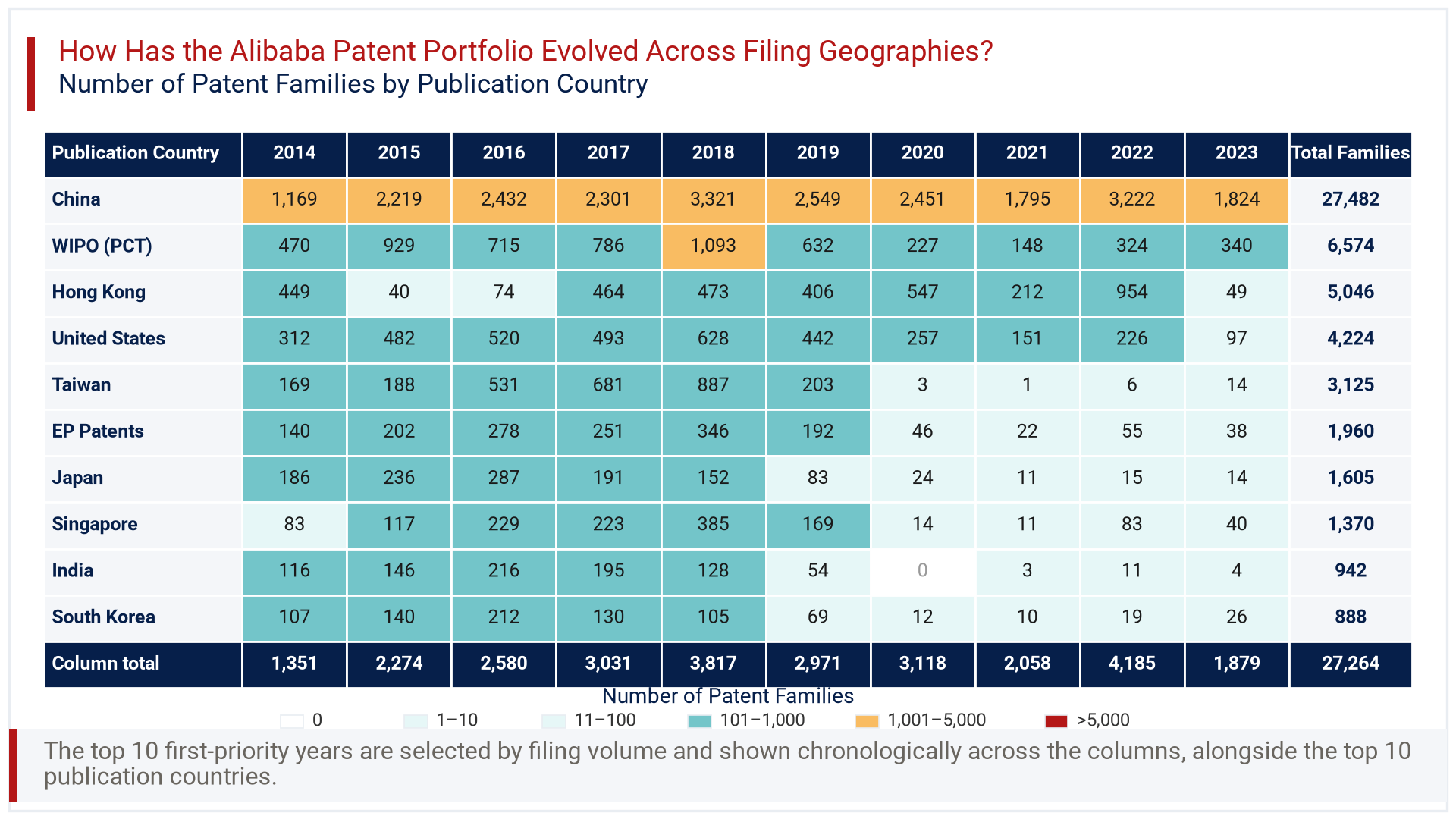
Other jurisdictions tell a sharper story of pullback. The United States peaked at 628 filings in 2018 and had fallen to just 97 by 2023. Taiwan shows an even steeper curve, climbing to 887 filings in 2018 before collapsing to single digits from 2020 onward. India followed a similar arc, moving from 116 filings in 2014 to effectively zero after 2019. Hong Kong is the outlier in this group, showing volatility rather than steady decline, including an unusual spike to 954 filings in 2022 after several quieter years.
Read together, this geographic timeline suggests Alibaba concentrated its heaviest international filing push between 2016 and 2018, then scaled back non-China filing meaningfully from 2019 onward — a shift that likely reflects both cost discipline in patent prosecution and a sharper focus on markets where the company sees direct commercial relevance.
Consultant’s Perspective on Alibaba Patent Portfolio
Taken as a whole, the Alibaba Patent Portfolio reads as a portfolio built primarily to protect a domestic commerce and cloud infrastructure business, with international filing used as a selective tool rather than a broad shield. The 84.6% concentration in China, paired with a technology base anchored in core data processing, is consistent with a company whose patent strategy follows its revenue geography closely rather than pursuing patent coverage for its own sake.
The steep pullback in non-China filings after 2018, and the retreat in overall volume after the 2022 peak, deserve monitoring rather than alarm — some of this is publication lag, but the multi-year trend in markets like Taiwan, India and the United States looks too consistent to be lag alone. It is plausible that Alibaba has become more selective about where international protection earns its cost, particularly as its cloud and AI investment (as detailed in its recent segment reporting) shifts commercial priorities toward markets it already serves at scale.
For competitors, partners, and investors assessing this company, the practical read is straightforward: expect dense, actively defended patent protection inside China, and expect a thinner, more selective footprint elsewhere. Any due diligence exercise touching Alibaba’s AI, cloud, or commerce technology should validate specific families in the relevant jurisdiction rather than relying on aggregate filing counts alone.
Explore Deeper Insights with ExpertLancing Research
Patent filing data only tells part of the story — the real value lies in what it means for your specific market position, licensing strategy, or competitive assessment. ExpertLancing Research works with technology companies, investors, and legal teams to turn portfolios like this one into decision-ready intelligence, from freedom-to-operate checks to competitor benchmarking and technology whitespace mapping. If you are evaluating Alibaba, or any company operating in adjacent technology spaces, get in touch with our team to commission a tailored analysis built around your specific business question.